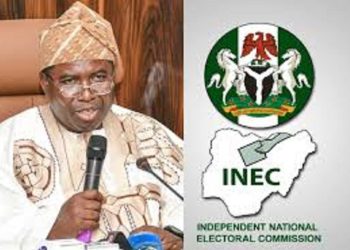


The Independent National Electoral Commission (INEC) has cautioned politicians and their supporters against the use of the inflammatory slogan, “rig and die”, ahead of the 2027 general elections.
The warning was issued by INEC National Commissioner and Chairman of the Information and Voter Education Committee, Mohammed Haruna, on Monday, November 23, 2026, in Abuja, during the commission’s zonal forum with media stakeholders.
The forum was attended by representatives of the Nigeria Union of Journalists, Nigerian Institute of Social Media Analysts, Newspaper Proprietors Association of Nigeria and other media executives.

Haruna, who was represented by the INEC Deputy Director of Information and Publicity, Wilfred Ifogah, said slogans linking electoral offences with death were dangerous and capable of triggering violence at polling units.
He said the people most exposed to such violence were not necessarily political leaders, but ordinary Nigerians working as Presiding Officers, Assistant Presiding Officers, Collation Officers and other ad-hoc electoral personnel.
According to him, voters, party agents and election observers could also become victims, if inflammatory rhetoric created tension at polling units.

He warned that a charged crowd could easily mistake a delayed result, technical difficulty or unverified rumour for evidence of electoral malpractice, with potentially fatal consequences.
“Rigging is a crime, and the Electoral Act 2026 prescribes penalties for it. The remedy lies in the law,” he said, urging Nigerians to rely on formal complaints, security agencies and the courts rather than resorting to violence.
Haruna added that the right to life was guaranteed by Section 33 of the Constitution and that nobody should lose their life merely because of suspicion of electoral malpractice.
The INEC commissioner urged political leaders to abandon violent rhetoric as the country approaches the 2027 elections.
He also appealed to journalists and media organisations not to amplify threats through sensational headlines or trending hashtags, stressing that such content could further inflame an already tense political environment.
Haruna said threats of violence should not be regarded as part of normal political debate, noting that security agencies had a responsibility to act on credible threats.
He also assured journalists that no media professional should be intimidated for performing legitimate duties, stressing that a free press and a safe election were interconnected.
Haruna said INEC would also hold its own officials and ad hoc personnel accountable where they were found to have compromised the electoral process.
He noted that the Electoral Act provides penalties for offences including result manipulation, vote buying and attempts to frustrate the upload of polling unit results to the INEC Result Viewing portal.
The commissioner said the commission was also working to ensure that electoral officials and materials arrived at polling units early on election day.
He explained that INEC was targeting deployment of officials and materials by about 7:30am, noting that unnecessary delays could create suspicion and tension among voters.
Haruna also dismissed viral claims circulating on social media that Nigerians would be allowed to vote in the 2027 elections without their Permanent Voter Cards.
He described the claim that the introduction of the Bimodal Voter Accreditation System had made PVCs unnecessary as false and potentially capable of disenfranchising unsuspecting voters.
He said Section 47(1) of the Electoral Act 2026 requires every person intending to vote to present a valid PVC for accreditation at the polling unit where the person is registered.
According to him, BVAS verifies the PVC and the biometrics of the person presenting it but does not replace the card.
He therefore reiterated the commission’s position that there would be no accreditation without a PVC and consequently no ballot paper for anyone who had not been accredited.
Haruna urged eligible voters who had not collected their cards to do so without delay and advised citizens to contact INEC directly whenever they needed clarification on electoral procedures.
The national commissioner also called on journalists, social media analysts and other media stakeholders to help the commission combat fake news, deepfakes, cloned voices and artificial intelligence-generated disinformation ahead of the 2027 elections.
He warned that the creation and circulation of certain forms of false content could constitute an offence under the Cybercrime Act.
Haruna recalled the circulation of false claims and AI-generated content during the Osun governorship election, which he said forced INEC to spend valuable time responding to and debunking misinformation.
He said the experience demonstrated the need for journalists and members of the public to verify election-related claims before publishing or sharing them.
Meanwhile, INEC announced plans to conduct a nationwide mock accreditation and voting exercise on November 28 ahead of the 2027 general elections.
The exercise will take place across two polling units in each Registration Area in all 36 states and the Federal Capital Territory.
Haruna said the mock exercise would run from 8:30am to 2:30pm and would be used to test the BVAS as well as the uploading of polling unit results to the INEC Result Viewing portal.
The exercise is part of preparations for the January 16, 2027 presidential and National Assembly elections.
Haruna also urged the media to sustain voter education, particularly on PVC collection and voter turnout, noting that only 26.72 per cent of registered voters participated in the 2023 presidential election.
He tasked journalists with investigating and exposing vote buying while partnering with INEC to defeat disinformation, deepfakes, fake accounts, threats and incitement ahead of the 2027 elections.