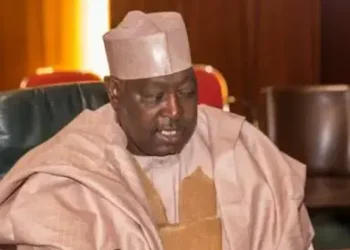


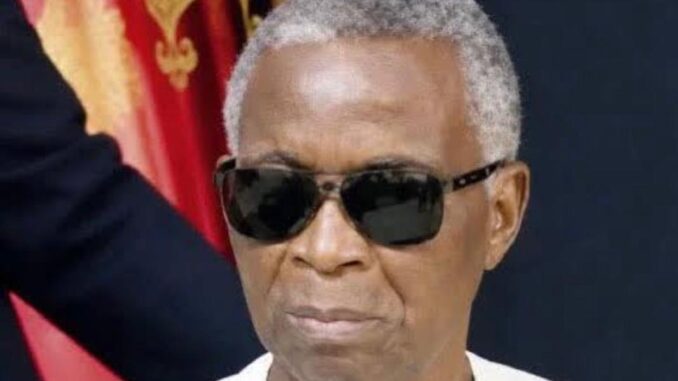
Professor Joseph Okwuabudike Ojukwu, elder brother of the late Biafran leader and former military officer, Chief Emeka Odumegwu-Ojukwu, has clocked 100 years, marking a remarkable century defined by medicine, surgery, public service, family responsibility, business and community life.
Born on September 26, 1926, at Akamili, Umudim, Nnewi, Anambra state, Joseph is the eldest son of the prominent Nigerian businessman, Sir Louis Philip Odumegwu Ojukwu, and Ogbenyeanu Janet Malize of Ukpor. Blueprint reports
His 100th birthday on September 26, 2026, places him among the Nigerians whose lives have traversed some of the country’s most defining historical periods, from the colonial era and independence to the Nigerian Civil War and the development of post-war medical institutions.

Unlike his younger brother Emeka, whose name became closely associated with Nigeria’s military and political history, Joseph Okwuabudike Ojukwu built his reputation primarily in medicine. He became a distinguished surgeon, clinical professor and mentor to generations of medical professionals, while maintaining a relatively quiet public profile.
*From King’s College to medical training in Britain
Ojukwu’s early years were shaped partly by Lagos, where his family lived before he proceeded to King’s College, Lagos, one of Nigeria’s foremost secondary schools.
At King’s College, he distinguished himself not only academically but also in leadership. He served as Head Boy while still a student, a position that reflected the confidence placed in him at an early stage of his life. His younger brother, Emeka, later attended the same institution.

Following his secondary education, Joseph travelled to Britain for medical training. His professional qualifications included M.R.C.S. England and L.R.C.P. London, both obtained in 1951, followed by the M.B., B.Chir. qualification from the University of Cambridge in 1952. Historical records also list his medical qualifications in Nigeria.
He subsequently specialised in surgery and became a Fellow of the Royal College of Surgeons of England, establishing the professional foundation for what would become a long and distinguished medical career.
*Building a medical career in Nigeria
On returning to Nigeria, Ojukwu joined the University College Hospital, Ibadan, where he began building his reputation as a medical practitioner.
He later moved to Lagos and became a Consultant Surgeon at the General Hospital, where he continued to develop his expertise in surgery.
The political crisis that engulfed Nigeria in the 1960s, culminating in the Civil War, altered the circumstances of the Ojukwu family. Joseph moved to the East but remained committed to his medical calling.
He worked in several hospitals in the former Eastern Region, including the Specialist Hospital, Enugu, Queen Elizabeth Hospital, Umuahia, and Emekuku Catholic Hospital.
His professional journey eventually brought him back to Enugu, where he continued his career at the Specialist Hospital, which later became the University of Nigeria Teaching Hospital, UNTH. It was there that he further established himself as one of the respected medical figures of his generation.
*‘Pa Ojukwu’ and the teaching of medicine
Over the years, colleagues, patients and associates came to affectionately call him “Pa Ojukwu”, a name reflecting both his seniority and the respect he commanded in medical circles.
His reputation extended beyond his technical competence as a surgeon. Accounts of his professional life describe him as devoted to his work, selfless, humble and strongly committed to professional integrity.
His contribution to medicine went beyond treating patients. As he advanced in his career, he became a Clinical Professor of Surgery, enabling him to contribute to the training and development of younger medical professionals.
In that capacity, his influence extended beyond the operating theatre to the classroom and teaching environment, allowing his experience to benefit successive generations of doctors.
He eventually retired from active medical service in 1987, after decades of professional practice.
*National recognition
Ojukwu’s contribution to medicine and public service received formal national recognition in 1983 when the Federal Government under President Shehu Shagari conferred on him the national honour of Member of the Order of the Federal Republic, MFR.
The honour came several years before his retirement and represented official recognition of a career that had already spanned decades of medical service.
Yet, despite the distinction, Ojukwu maintained a relatively low public profile, with much of his influence exercised through his profession, family and community rather than through political prominence.
*A life beyond medicine
Medicine, however, was only one part of Ojukwu’s century-long journey.
As the eldest son of Sir Louis Philip Odumegwu Ojukwu, he also carried significant family responsibilities. He maintained a longstanding connection with the family’s business interests and has been associated with Ojukwu Transport Limited since 1952, eventually becoming its chairman.
He was also appointed an executor of his late father’s estate and remains the surviving executor, a responsibility that placed considerable trust in his judgement and sense of duty.
His role as the eldest son gave him a distinctive place within the family, particularly during periods of profound national and personal upheaval.
*Family man and elder brother
In December 1957, Joseph Ojukwu married Maria Ukamaka Aghaji at St. Michael’s Church, Umudim, Nnewi.
The marriage produced six children — Ogonna, Ike, Chukwudi, Ukonwa, Nnanna and Chizoba — who went on to pursue professional careers in fields including law, medicine, engineering, optometry and accountancy. The family has also been blessed with grandchildren and great-grandchildren.
His wife, Maria, who was also known as Ifeoma, died in 2006, shortly before the couple would have marked their 50th wedding anniversary.
Within the wider Ojukwu family, Joseph occupied the position of elder brother to Emeka Odumegwu-Ojukwu, whose historical role during the Nigerian Civil War made the Ojukwu name nationally and internationally prominent.
The contrast between the two brothers is striking. While Emeka pursued a military career and later became the head of the breakaway Republic of Biafra, Joseph devoted his professional life principally to medicine and surgery.
His story therefore represents another, less publicly documented dimension of the Ojukwu family’s history.
*A century spanning Nigeria’s transformation
At 100, Joseph Okwuabudike Ojukwu’s life provides a unique window into the evolution of Nigeria itself.
He came of age during the colonial period, received his education at one of the country’s leading schools, travelled to Britain for professional training and returned to serve in Nigeria’s emerging healthcare system.
He worked through the turbulence surrounding the Civil War, served in hospitals across the former Eastern Region, participated in the development of post-war medical institutions and helped train younger medical professionals.
His career also coincided with major changes in Nigeria’s healthcare system, particularly the development of teaching hospitals and specialist medical services.
Beyond the profession, he remained connected to his family, community and business responsibilities, giving his long life several intersecting dimensions.
*A legacy defined by service
Recent accounts of his centenary have consistently portrayed Ojukwu as a man whose influence was expressed more through service than public visibility.
His professional legacy is reflected in the medical institutions where he worked, the patients he attended to and the younger professionals he helped train.
His national recognition through the MFR, his rise to Clinical Professor ofn Surgery and his decades of service demonstrate the scale of his contribution to Nigerian medicine.
At the same time, his family responsibilities, business involvement and role as an elder within the Ojukwu family added another dimension to his life.
He has also been honoured within his community, including with the traditional title of Chimelumdibia Nnewi by the Igwe of Nnewi, according to recent biographical accounts.
His centenary is therefore more than a numerical milestone. It represents 100 years of a life lived across different generations of Nigeria, with medicine serving as the central thread of a career that touched healthcare, education and professional development.
For a man born in 1926, reaching 100 years means witnessing the country move from colonial rule to independence, through civil conflict and successive political transitions, while experiencing profound changes in medicine, education, business and society.
Professor Joseph Okwuabudike Ojukwu, MFR, enters his second century as a physician, surgeon, professor, businessman, family patriarch and elder whose life offers a distinctive chapter in Nigeria’s history.
His journey, largely away from the political spotlight that surrounded his famous younger brother, remains a story of professional dedication, family responsibility and quiet distinction.
At 100, “Pa Ojukwu” stands as a living link between generations – a man whose century has encompassed both the turbulence and transformation of modern Nigeria, and whose enduring legacy is rooted in the lives he served, the professionals he influenced and the family responsibilities he carried.