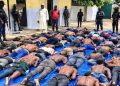


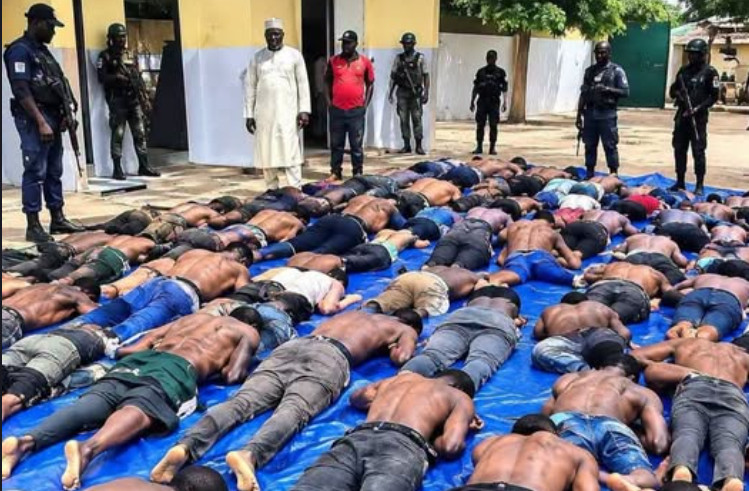
What began as an enforcement operation against suspected illegal mining in Minna, Niger State, has turned into a deeply troubling tragedy, with 37 young miners dying while in the custody of the Nigeria Security and Civil Defence Corps (NSCDC), triggering protests, official investigations, suspensions, a presidential directive and growing demands for justice.
In this Weekend features, News Point Nigeria dissects and analyses the situation, tracing the events from the arrests of the suspected miners, the conflicting accounts surrounding their deaths, the testimonies of survivors and relatives, the findings and observations at Minna General Hospital, the protests that followed, and the multiple investigations now underway to establish what actually happened inside the detention facility.
The incident has raised difficult questions about the circumstances under which the young men were detained, the condition of the facility, the number of people held there, the medical attention available to them, what happened during the night the deaths occurred, and whether negligence, overcrowding, suffocation, poisoning, disease or another factor was responsible.

For now, no definitive cause of death has been established. The NSCDC initially attributed the deaths to a suspected disease outbreak, while its national headquarters subsequently cautioned against drawing such a conclusion before medical and laboratory examinations are completed.
But accounts from survivors, relatives, hospital officials and government authorities have introduced a series of disturbing details that have widened the scope of the questions surrounding the tragedy.
The NSCDC Niger Command said its personnel conducted what it described as a “burst operation” on September 15 and 16 around the M.I. Wushishi Estate and Lukoto Village areas of Minna.

According to a statement issued by the Niger State Commandant, Suberu Siyaka Aniviye, the operation resulted in the arrest of scores of suspected illegal miners.
The command said that in the early hours of Thursday, September 17, some of the detained suspects were found dead following what it described at the time as a suspected outbreak of disease.
The command did not, however, name the disease or initially provide a detailed account of what happened inside the detention facility.
It also did not provide detailed information on the physical condition of the cell, the number of people being held there, the medical arrangements available to the detainees or the precise sequence of events between their arrest and the discovery of the bodies.
The NSCDC national headquarters later adopted a more cautious position, saying the actual cause of death had not been established and that medical and laboratory examinations would be necessary before any conclusion could be reached.
That uncertainty has remained at the heart of the controversy.
New facts have since emerged from the incident, including an account by one of the survivors who said the detainees were sprayed with an unknown substance while they were inside the cell.
The survivor, whose identity was withheld for safety reasons, gave the account when Niger State Governor Umaru Mohammed Bago and the Minister of Interior, Olubunmi Tunji-Ojo, met with him and two other survivors to hear what had happened.
He said NSCDC officials took about 67 of them and placed them inside a cell.
According to him, the detainees repeatedly told the Civil Defence officers watching over them that they were hot and needed something to drink, but their pleas were ignored.
“After sometime, they sprayed something from a bottle, and that was when several people started shouting and falling.”
The survivor was unable to identify the substance despite repeated questions from the minister and the governor, who wanted to ascertain exactly what had been sprayed on the detainees.
The survivors also said they were not given water and that their families were not allowed to bring water to them. The Minister of Interior assured them that justice would be done and that the government would get to the root of the matter. That testimony has become one of several competing accounts now awaiting verification through the ongoing investigations.
Governor Bago said preliminary forensic observations from the hospital and mortuary had raised further questions. According to him, some of the corpses had foam in their mouths and bloodstains, while parts of the skin of several others appeared to be peeling.
“So we cannot rule out methane or cyanide or lead poisoning in this. However, there is need for proper investigation into the root cause of this,” he said.
The governor also sharply criticised the suspended Niger State Civil Defence Commandant, Suberu Siyaka Aniviye, describing his decision to detain such a large number of people for more than 24 hours in a cell that could not accommodate them as “callous and reckless.”
“His action was callous and reckless.
“And also the officers that were on duty, even after hearing the scream from the people in the cells to say they were dying, they kept deaf ears to those pleas, and we woke up with a very sad thing,” Bago said.
The governor’s comments further shifted the focus from the alleged illegal mining activities that led to the arrests to the conditions under which the suspects were held.
The accounts provided by survivors were markedly different from the initial suggestion of a disease outbreak. One survivor, Dauda Shehu, an indigene of Allawa in Shiroro Local Government Area, said the detainees were packed tightly into the cell, with inadequate ventilation.
“We were jam-packed, no ventilation for us to breathe well,” Shehu told our correspondent. “All of a sudden, we realised that we could not breathe and we were all scampering for where to get fresh air. We even appealed to them several times, banged the cell door but they refused to answer us.
“Even when we raised the alarm that some people were already dying because of suffocation, nobody answered us. They were watching us grasping for air to breathe and screaming for help but they ignored us.”
Shehu also questioned the official death figures and the number of survivors who were taken to hospital. He said 65 people had been arrested and detained in the cell.
“Out of the 65 of us that were in the cell, they brought only six of us to the General Hospital. Where are the remaining 26 people if they claimed it is only 33 that died?
“We were 65 people that they arrested,” he said.
Another survivor, who declined to disclose his name, said the deaths started during the night and continued into Thursday morning. He said those who survived were closer to the entrance of the cell and were able to scream for help.
“We survived because we were close to the entrance and we were screaming for help. Some people died last night, and more died this morning. “Even when we were telling them that people were dying, they did not believe us,” he said.
Another dimension of the tragedy emerged from the survivors’ accounts. Some of those arrested were said to be residents of Allawa who had fled their homes because of bandit attacks and subsequently turned to mining as a means of earning a living.
“We were chased away from our homes in Allawa by bandits. We are just trying to earn a living. We do not carry arms or weapons, they are lying,” one survivor alleged.
Shehu also alleged that some of the detainees were arrested after they could not pay what he described as a mandatory N150,000 fee per mining pit allegedly demanded by officers.
He said those unable to pay were arrested on Wednesday. The two survivors who spoke about the detention put the number of people held in the cell at about 65 to 66, while questioning the whereabouts of others.
One survivor described the heat inside the cell as overwhelming, saying the detainees were sweating heavily and struggling for water. Some, according to the account, resorted to using urine as a substitute.
The families also alleged that access to water was severely restricted. According to testimonies recounted to our correspondent, detainees repeatedly complained about thirst and were given only a small quantity of water for a large number of people.
These allegations remain subject to investigation.
At the General Hospital, Minna, where the bodies were taken, the Medical Director, Dr Isa Mohammed Danasabe, said 37 corpses were received on Thursday afternoon. He added that seven other detainees who were still alive were brought to the emergency ward, treated and later discharged.
What killed the 37 people, however, remained unresolved. Danasabe said the bodies were transported in two ambulances and were piled on top of one another because of their number.
When the hospital examined the corpses physically, he said, there were minimal visible signs of torture or injury.
“They were generally examined. There were minimal signs of torture or injury, so to say. So it didn’t appear as if they were tortured when we physically examined them.”
That observation, however, does not establish the cause of death, nor does the absence of obvious external injuries answer questions surrounding possible oxygen deprivation, poisoning, heat exposure, infection, chemical exposure or another internal cause.
The doctor also said the seven survivors brought to the hospital were in severe distress, with some foaming at the mouth when they arrived.
“They were in distress and we resuscitated them and they are alive,” he said, adding that they responded to treatment and had been discharged as of Friday morning.
Danasabe further said one of the medical officers reported that some of the survivors had marks or injuries and told him they had been biting one another while detained.
For Abdullahi, the tragedy became personal long before the full scale of the deaths emerged. On Wednesday, he went to deliver food to his 17-year-old son, Salim, who had been detained after a raid on a mining site in Minna.
Abdullahi said Salim was among dozens of young men arrested by NSCDC operatives during an operation against suspected illegal mining. The family had already spent days trying to secure his release but were told to wait.
So, when the family took food to the detention facility on Wednesday, there was little reason to imagine that it would be the last time they would hear from Salim.
“He ate and they were okay,” Abdullahi recalled. The following morning, the family returned with more food. But this time, they did not meet a hungry son waiting behind a cell door. They met a dead son.
“It was when we came this morning to give them food that we saw that my son and many others were already dead,” Abdullahi said.
Salim was not alone.
By the time the deaths became public on Thursday, September 17, Minna had been transformed from the scene of an anti-illegal-mining operation into the centre of a growing public crisis over what happened to the people detained during that operation.
The Niger State Government put the death toll at 37.
Abdullahi said Salim had left home three days before his death and that the family knew he had gone to the mining area to work. The family later learnt that Civil Defence operatives had arrested him.
“For the past three days, we have been coming and appealing to the Command for their release, but the Civil Defence officers told us they could not release them,” Abdullahi said. He said the family continued taking food to the detainees.
“They were alive when we brought food,” he said. Then came Thursday morning. The food the family brought had no one to eat it. Salim was dead.
“My son is not a thief. He does not steal or fight but only does mining to survive and to support us,” Abdullahi said. He said questions about whether the detainees had been poisoned or exposed to tear gas had been met with silence.
“What is their reason for killing my son and the others? We need justice. We will seek for independent autopsy.” Another relative, Malam Babawu, said the victims were people struggling to make a living.
For some of those arrested, mining was not simply about seeking quick money. Survivors said several detainees were from Allawa and surrounding communities that had been affected by bandit attacks.
Shehu said they had been displaced from their homes and turned to mining as a means of survival. “We were chased away from our homes in Allawa by bandits. We are just trying to earn a living. We do not carry arms or weapons; they are lying,” he alleged.
By Thursday evening and into Friday, grief had moved beyond the hospital. Anger spread into the streets of Minna.
Properties worth millions of naira were destroyed as youths took over parts of the Niger State capital to protest the deaths of the suspected illegal miners in NSCDC custody.
The protests began on Thursday night and escalated on Friday morning. At the time of filing the reports, the protest was still ongoing across the state capital.
Governor Bago had planned to visit the families of the deceased to commiserate with them but was unable to do so because of the protests.
The protests began around Tunga and Maitumbi before spreading to Kpakungu, Bosso, Tudun Natsira and Berger. Demonstrators blocked roads, notably at Flamingo Junction, while chanting for justice. In some areas, vehicles, public property and campaign materials were damaged.
Security forces, including police and soldiers, were deployed to restore order.
Several reports indicated the use of tear gas and, in some accounts, live rounds as protesters, some armed with sticks or other items, confronted security authorities.
Unconfirmed reports said several youths were shot.
One video showed a youth apparently shot in the face at the NSTA Park as he tried to use a knife to harm passengers. The circumstances surrounding the reported shooting could not independently establish the full sequence of events.
The youths invaded the NSTA Park and vandalised buses, including vehicles that were loading passengers for journeys and those that were not scheduled to travel. They also destroyed the goods and trading wares of traders around the park.
Passengers reportedly had to jump over fences in their bid to escape the unrest. The violence then spread to nearby financial institutions. GTB and Access Bank, both located close to the NSTA Park, were attacked.
Traders at Tunga Market who had already opened their shops hurriedly closed them to escape the aggrieved crowd.
Along Bosso Road, youths broke the glass windows at the Bahago Sports Complex security post in an attempt to gain access