

*Eulogises leadership qualities of African female CEOs
The Group Chairman, Heirs Holdings/Transcorp, Mr. Tony O. Elumelu, has charged policymakers across Africa, to jettison the need to globetrot looking for investors, but to put in place credible institutions to attract investors from across the world.
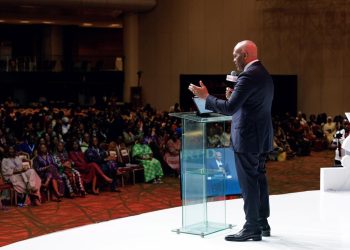
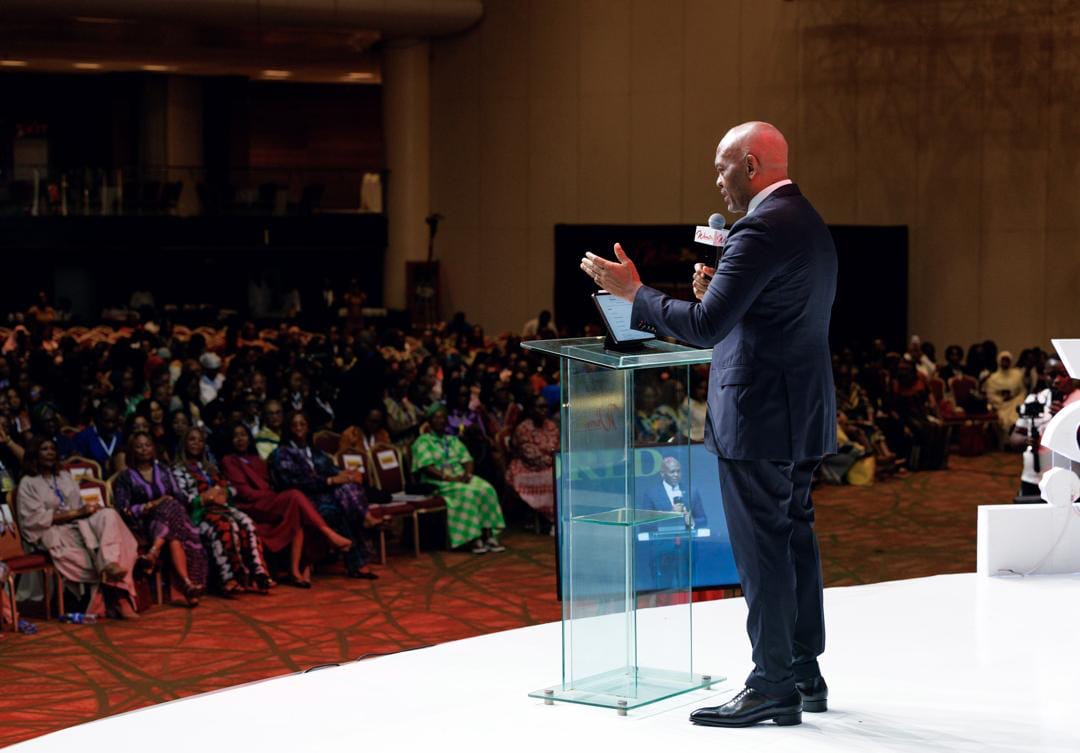
Speaking as the Special Guest Speaker at the 25th WIMBIZ Annual Conference, with the theme: “The Geography of Opportunity: Why The World Needs What Africa Has”, which held at Eko Hotel & Suites, Victoria Island, Lagos on Friday, November 06, 2026, the founder, The Tony Elumelu Foundation noted that “where institutions are credible, contracts are honoured and leaders are accountable, money and investors follow”.
Recalling his personal experiences, he stated that “having sat across the table from investors on every continent, they all ask the same questions. Will the contract be honoured? Will the regulator be predictable? Will the courts work? Will the power stay on? Capital goes where it is safe, and it stays where it is respected.
“So let me say to the policymakers across Africa, those who are here, and to those watching: you do not need to fly around the world asking investors to come. Create the right conditions, and they will come. Where institutions are credible, contracts are honoured and leaders are accountable, money follows. That is not theory. I have watched it happen in every market where we operate.
“And let me say something to the business leaders here. Institutions are not only built by governments. They are built by us. The private sector must also examine itself.
“We cannot demand good governance from public officials while tolerating poor governance in our own organisations.
“Every time you pay your taxes properly, publish your accounts, promote on merit, refuse the shortcut, you are building an institution.
“Every board you sit on that holds management to account is an institution. Every woman you mentor into a seat that was going to go to a less qualified man is institution-building”.
And remarking how his mother gave him necessary mentoring to get to where he is today, he stated: “I did not start with capital. I started with a mother who ran a small restaurant and worked harder than anyone I have ever known. I watched her turn very little into a living, and a living into a future for her children.
“That was my first business school. My first lesson in risk, in cash flow, in customers, in getting up the next morning when the day before had gone badly, came from a woman”.
He fuether stawd rhat “when people ask me whether women can lead African business, I find the question strange.
“In my experience, they already do. We have simply not given them the capital, the title or the credit.
“Later, people who did not have to open doors for me, opened them anyway.
“At 34, I led a small group of young Nigerians to buy a struggling bank that almost nobody else wanted.
“It became the foundation of everything that followed.
“I was not a better businessman the day someone believed in me. I simply got the chance to prove it. I call this democratising luck”.
He emphasised that businesses and leadership pportunity in Africa is still distributed by accident of birth, of geography, of gender, including that Africa is greatly endowed with all kinds of mineral resources and rare stones.
He stated that for Africa to make the desired impact and make exponential progress, it must give priority to merit rather than tribe and religion in all its ramifications.
“That is what Africapitalism means to me: the private sector creating economic prosperity and social wealth at the same time, and doing it for everyone, not for a fortunate few”.
He informed the gathering that they must realise that “the world needs what Africa has, but noted that by being imbued with assorted mineral resources, Africa is properly gifted to lead global energy transition.
“We have the land, the sun, the rivers and the youngest population on earth. Everyone else is ageing. We are not. That is not a problem to be managed.
“This is the single greatest commercial opportunity of this century, and it is ours.
“Africa is a continent blessed with extraordinary mineral wealth, immense agricultural potential, a young population, enormous cultural influence and a rapidly expanding consumer market.
“Yet too many of our people remain trapped in poverty.
“Too many of our young people see emigration as their most credible economic strategy.
“Too many of our entrepreneurs spend more energy navigating obstacles than building businesses.
“And too many of our countries remain dependent on exporting what nature gave us and importing what human ingenuity has transformed.
“We cannot talk about industrialisation without fixing electricity. Factories cannot run without it.
“Hospitals and schools cannot function without it. And the AI economy everyone is talking about has two basic ingredients: power and connectivity. Africa has the young, creative minds. What they lack is the grid. Fix electricity, and Africa will take off”.
Elumelu however added that Africa cannot get it right without changing current value reorientation.
“If the power is reliable and the environment is right, why ship raw lithium, raw cocoa, raw crude out of this continent? Refine it. Process it. Brand it. Then sell it to the world. That is how a continent moves from supplier to participant,” he emphasised.
Advising against seeking foreign aid, the Chairman emphasised that “the future is investment and trade, not aid.
“And that future will be built by people who look like the people in this room. And that capital needs to be African. Investment can only flourish with capital formation, which comes with savings”.
He reminded that “savings can only grow with a beneficial environment, consistent policy, trusted financial institutions.
“With savings growth, at national and continental level, Africa will not just offer solutions, but finance those solutions.
“And we are seeing it now in action. Our investment in Seplat, the London and Lagos listed oil company, has catalysed value in Africa for Africans, with this year the share price moving from £3 to £9, since our investment.
“And now with a current market cap of $7bn today. My brother Alhaji Aliko Dangote has mobilised retail African investors, in innovative ways for the Refinery IPO. We are witnessing a new dawn.
“And capital flows not just into stock markets. Our Foundation’s over $130m disbursements is an investment in entrepreneurs, in the next generation, in Africa’s future.
“We are spreading prosperity and opportunity by investing in our young ones.
“So, the most important thing Africa needs to build in the next decade is African capital that invests in Africa.
“Our pension funds, our insurers, our banks, our family offices. We must demonstrate that African capital can build African businesses that compete anywhere in the world.
“The narrative will not change because we talk about it. It will change by Africans taking control of their destiny.
“And let me add a fourth, because it is the one we can fix ourselves without asking anyone’s permission: we must trade with each other.
“It is easier today to ship goods from Lagos to Liverpool than from Lagos to Luanda. Less than a fifth of our trade is with each other.
“The African Continental Free Trade Area is the largest free trade area in the world by number of countries, and it will remain a document until businesses, your businesses, use it”.
He however stated that the efforts will not succeed without impactful investment and results achieved in roads, railways, ports, payment systems, efficient customs procedures, predictable regulations and reliable effective judicial system.
He advised against merely by signing documents, but build the physical, financial and institutional infrastructure that makes continental trade commercially viable.
“A continent that cannot trade efficiently with itself will struggle to negotiate effectively with the rest of the world. We need to think beyond national borders.
“We need African businesses that see the continent as their natural home market; African banks that finance cross-border expansion; African manufacturers that build regional supply chains; African technology companies that solve problems at continental scale; And African policymakers who recognise that regional integration is not a threat to national sovereignty, but a means of strengthening our collective economic capacity”.
He noted that for over 15 years, his wife Awele and himself, through the Tony Elumelu Foundation, have put more than 120 million dollars of seed capital into 24,633 young entrepreneurs, in all 54 African countries, of which 48 per cent of them are women.
“Not because of a quota. Because our selection process is objective and we judge on the quality of the business plan alone.
“Those entrepreneurs have created more than 1.5 million jobs and generated more than 4.2 billion dollars in revenue. Harvard Business School now teaches how we did it. And I will tell you something the case study does not: our women entrepreneurs succeed, re-invest and re-hire at rates our male entrepreneurs should envy”.
He cited the example of only three: Princess Adeyinka Tekenah, who received $5,000 from us in 2015. She built Happy Coffee, seed to cup, in a country where ninety per cent of coffee is imported, buying her beans from women farmers in Taraba State. More than a thousand jobs. She organized the first Lagos Coffee Festival. She intends to be the first publicly listed Nigerian coffee brand, and I would not bet against her.
Olamide Ayeni-Babajide, whim he said, “took $5,000 in 2016 and built a recycling company from tyre waste. Revenue up more than twenty-fold. Fifteen thousand people trained, most of them women and girls.
“Nkem Okocha received $5,000 from us in 2015. She built Mama Moni, a Fintech Social Enterprise that is closing the credit gap for low-income female entrepreneurs in rural and urban slum communities in Nigeria through easy access to finance.
“Mama Moni’s web platform enables socially conscious individuals to invest in low-income women by lending to them to fund their businesses.
“Three women. Fifteen thousand dollars between them. Thousands of jobs. Now tell me the world does not need what Africa has”.
Highlighting the progress and challenges encountered by the Tony ElumeluFoundation, he stated that this year alone, 265,529 young Africans with groundbreaking business ideas applied to our programme.
“We could only fund 3,200 — just one in every 83 applicants. Think about the more than 262,000 innovative ideas and businesses we could not support.
“That is not a shortage of entrepreneurial talent; it is a shortage of capital. That is the scale of the opportunity Africa must unlock, and the capital we must mobilise. Not from Abu Dhabi, Washington or Brussels alone, but from Lagos, Nairobi, Johannesburg and this very room.
“Women’s economic leadership is not a concession to fairness. It is a requirement for competitiveness.
“No serious economy can afford to systematically underutilise half its talent.
“And no continent seeking to accelerate its development can continue to treat women’s advancement as a peripheral social objective.
“Inclusive prosperity is not charity. A continent that ignores half its talent is competing with one hand tied behind its back”.
He gave the example of his wife, Awele, who co-founded the Tony Elumelu Foundation with him, now chairs the family-owned oil producing company – Heirs Energies which is today the 6th biggest producer of oil in Nigeria, producing 70,000 barrels of oil per day.
He also cited the example of Transcorp Group PLC, one of Nigeria’s largest listed conglomerates, which appointed another female, Owen Omogiafo as President and Group Chief Executive, who succeeded in transforming Transcorp to become a power company, a hospitality company that competes with any other on the continent.
And when Owen moved to another assignment, Awele Elumelu took over as its Chairman, while Uzo Oshogwe, from running Afriland Properties, after thirty years at UBA and Accenture took over as the Managing-Director.
“By the time Owen took the top job, women held 80 per cent of the senior management positions at Transcorp. I did not do it for a headline. I did it because they were the best people for the jobs.
“At the Tony Elumelu Foundation, the chief executive is Somachi Chris-Asoluka. The Foundation that has deployed more capital to African entrepreneurs than any other on this continent is run by a woman.
“And Somachi is a tribute to our nurturing of talent, joining our Group as a junior, straight after her post graduate degree at Yale and rising – as so many others have done.
“In total, the Heirs Holdings Group has eight female leaders as Chairperson/CEOs; Agatha Obiekwugo – Chairperson, Afriland Properties Plc; Owen Omogiafo, OON – President/GCEO, Transnational Corporation Plc; Uzo Oshogwe – MD/CEO, Transcorp Hotels Plc; Somachi Chris-Asoluka – CEO, The Tony Elumelu Foundation;Catherine Nwosu – MD/CEO, Africa Prudential Plc; Dr. Odiri Ogini – MD/CEO, United Capital Asset Management; Adetola Fasuyi – MD, United Capital Wealth Management and Esther Adeola Balogun – MD/CEO, UCEE MFB.
He reminded the gathering that when WIMBIZ, 25 years ago, held its first conference, “the women on that stage could not have named a female chief executive of a listed Nigerian company.
“Today you can name several, and some of them work for me. In another 25 years, the women on this stage should be reading your name.
“And I want to say to WIMBIZ itself: the next twenty-five years must be bigger than the last”.