

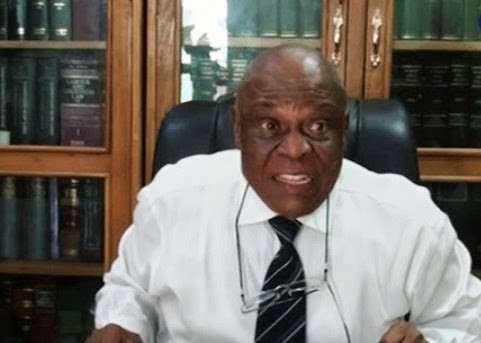
A senior and veteran lawyer, Amobi Nzelu, the Principal Partner at Chinenye Chambers, spoke extensively on Nigeria’s judiciary, political leadership, national unity, corruption and the need for citizens to demand accountability from those entrusted with public resources. In this interview granted during a New Yam Festival he organized at his residence in Abuja, he reflected on his years as a legal practictioner in Maiduguri, his involvement in a controversial pro-bono human-rights case involving alleged extrajudicial killings: The Apo Six, during which six Igbo traders were allegedly killed by the police, in 2005, and his philosophy of bringing people together. Excerpts.
You are celebrating the New Yam Festival today at your residence and invited friends and associates. What is the essence of the gathering?

I am not a farmer; I am a lawyer. But, I believe there must be occasions that bring people together to meet, interact and exchange views. Every first Saturday of September, I set aside the day to eat new yam and invite friends and associates to felicitate and thank God with me.
It is not because I am a traditional title holder. I am not one, and I do not intend to become one. Rather, I use the occasion to bring people together from different backgrounds. We sit down, talk, exchange ideas and get to know one another.
If tomorrow you see somebody who attended this gathering, you can say, “Yes, I know this man.” That is important because sometimes people form opinions about others based on what they hear. Personal interaction helps to correct such misconceptions.

You mentioned that you practised law for several years in Maiduguri. How did you get there?
After I was called to the Bar, I was posted to Maiduguri for my National Youth Service (NYSC). I initially wondered why I was being sent so far away when others were getting postings to places of their choice. I went back to my father, who was then working in the Ministry of Defence, expecting him to intervene. But he told me that I should go and serve there and learn how people behave in another part of the country.
That decision eventually changed my life. I spent about 15 years in Maiduguri. It was there that I met my wife, and my five children were born there before I eventually relocated to Abuja in 1995. What was initially regarded as a punishment became a blessing. Today, many of my contacts are from the North because I lived and worked among them.
You became prominent because of your role in the Apo six extrajudicial murder case. Looking back, do you have any regrets?
The matter was extremely emotional. The circumstances surrounding it brought me to a different level in my relationship with God. I had a dream in which I was told to tell the world that the people who were killed were not armed robbers, as had been claimed to be by the police. I was also assured that I would be protected of I carried out that instruction I received in a vision. The following day, I was contacted by people connected to the families of the victims. That was how I became involved.
I do not claim that I personally defeated the police. I regard myself as an instrument carrying out an assignment. The police had weapons, authority and resources. I was simply a lawyer pursuing what I believed was just and we proved our case.
What eventually exposed what happened?
Photographs became very important. Initially, there was an argument that photographs had not been taken. But the photographer who was called to the scene had used two cameras. The police took one of the cameras, but he had another small camera with him. The photographs from that second camera eventually became the source of important evidence.
When those photographs were presented, questions were raised about the credibility of the police account. Eventually, the police had to recuse themselves from the inquiry because they could not be both parties and judges in the same matter.
The federal government set up the Justice Olasumbo Goodluck Judicial Panel of Enquiry, which examined all the evidence, listened to testimonies and passed a bereft of culpability by the police and made far reaching recommendations, including payment of compensation to families of the deceased, clearing them of all the allegations levelled against them by the police to be innocent Nigerians, Igbo traders and that their bodies should be exhumed and given decent burial in the respective homes of the deceased. The bodies of the victims were later exhumed, preserved and eventually returned to their families for burial after the inquiry.
You have also had a major legal victory involving former NITEL workers. What happened?
The workers came to me after they had been affected by the privatisation process. They had no money to prosecute the case, so we entered into an agreement under which I would finance the proceedings. I took the matter to court in 2007 and won. It went on appeal, and the appellate court also ruled in their favour. Eventually, the government ordered the payment of their entitlements.
There was an agreement on my professional fees, but the workers later appealed to me to reduce my share so that they could receive more. I agreed, and the matter was settled. For me, it was another reminder that if you remain faithful to your principles and do not compromise, things can eventually work out.
What is your assessment of the judiciary today?
I am deeply concerned. The judiciary is supposed to be the last hope of the ordinary man, but there is a perception that money and corruption has entered the system too deeply. I am not saying every judge or legal practitioner is corrupt. There are still several good and upright judicial officers and lawyers. But the system is under serious pressure, and financial inducements can undermine justice. What we were taught as lawyers was that justice must be done without fear or favour. That principle must be restored.
With the 2027 elections approaching, what should the judiciary do to protect democracy?
The judiciary must stand upright. Democracy cannot survive if the institution that is supposed to resolve electoral disputes is compromised.
The inducements are enormous, but anybody who truly fears God and understands the consequences of destroying democracy should be able to say no. Judges must be courageous, impartial and independent. The judiciary must remain a place where ordinary Nigerians can obtain justice.
What about the legislature?
I am also worried about the cost of running the legislature. In a country where many people go to bed hungry, without knowing where their next meal will come from, spending huge amounts of money on official vehicles and other privileges which is difficult to justify. Politicians spend enormous amounts of money getting elected, and when they get into office, they try to recover what they spent. That creates a dangerous cycle.
Public office should not be an avenue for recovering election expenses.
With the judiciary, legislature and executive facing criticism, where is the hope for Nigeria?
The hope lies in our resolve to say no and ask questions. If someone is spending many times above his legitimate income, Nigerians should ask: where did the money come from?
We have become too complacent. We have allowed politicians to divide us along religious and ethnic lines. Yet, all of us go to the same markets and live in the same country. We must begin to ask questions about those who govern us and demand accountability.
What would you say about ethnic politics and the argument that an Igbo should not become president of Nigeria?
That kind of thinking is not wise. If a person has the competence, character and capacity to lead, his ethnic background should not disqualify him. Other countries have elected leaders from minority backgrounds because they saw merit in them. Nigeria should learn from that. We should judge people by what they can offer the country, not simply by where they come from.
Finally, what is your message to Nigerians?
We must stop expecting everything to happen through prayer alone. Prayer and hard work are complementary. After praying, go out and look for what to do. God can bless the work of your hands, but you must make the effort.
Nigeria can still change. But Nigerians must become more courageous, more questioning and more committed to justice.