

By Ike Abonyi
“Compromise is the art of dividing a cake in such a way that everyone believes he has the biggest piece” — Ludwig Erhard
The January 16, 2027, presidential election is significant for numerous historical reasons. It offers the politically dominant Northern region an opportunity to rectify the error it committed 27 years ago through the young officers of that era, led by Generals Ibrahim Babangida, Abdulsalami Abubakar, and Aliyu Gusau. These three influential figures, whose effects on Northern politics remain evident, are all still alive and observing the consequences of the path the region—and the country as a whole—has taken because they firmly rejected the counsel of Northern political elders, then led by former President Shehu Shagari and Maitama Sule.
The elders had urged the military leaders in power at the time to transfer authority to Dr Alex Ekwueme, who had successfully organised the politicians and prepared them to assume power from the military.
For those Northern elders, a handover to Ekwueme would have ensured a smooth continuation of the longstanding political partnership between the North and the East. This relationship had functioned effectively and helped stabilise the country before the soldiers brought it to an end in 1983.
Moreover, they regarded Ekwueme as an excellent choice because he had served as Shagari’s Vice President for four years, acting as a versatile partner in the administration.
But the soldiers resented Dr Ekwueme’s boldness in challenging the military and effortlessly rallying politicians to discredit them. Instead, they wanted Ekwueme to go for the Senate President position, an offer he rejected outright; not after being number two, turned around years later to go for the number three position. The Generals were also more focused on restoring military solidarity and cohesion, which General Sani Abacha had seriously undermined by imprisoning their two highly respected senior officers, Generals Olusegun Obasanjo and Musa Yar’Adua, the latter of whom died in custody. For the soldiers, placing Obasanjo, who was not genuinely interested but was persuaded, ahead of Ekwueme addressed two critical problems they had created: appeasing the military community over Obasanjo’s treatment and Yar’Adua’s death, and placating the ethnic Yoruba, who had lost Chief Moshood Abiola in the political crisis.
A senior Northern political leader recently told me about the North’s regret over that political miscalculation. In 1998, those elders had conveyed the message to the soldiers metaphorically: if you must lend your wife to someone, it should be someone who will cause her the least possible harm by the time she is returned to you.
Looking at the region today and what it has become — a battleground, a centre of poverty production, a visibly divided region, and a political battlefield — is deeply disheartening. During this political era, the region has produced two presidents, Umaru Yar’Adua and Muhammadu Buhari, and lost both of them. It has also produced three vice presidents: Atiku Abubakar, Namadi Sambo, and Kashim Shettima. Although all three are alive, they are politically embattled. Nigeria as a whole has remained in a political coma. After 27 years of uninterrupted so-called democracy, the country has arrived at a Bola Tinubu presidency under which 35 million citizens live below the poverty line, while Nigeria is shamefully ranked among the 60 poorest countries in the world. This is a nation counted among the ten most naturally endowed countries globally, with virtually every valuable resource beneath its soil by God’s design. Yet, what it abundantly offers the world is unprecedented poverty fueled by unprecedented corruption in high places.
Since this political dispensation began in 1999, Northern leaders have metaphorically held the knife and the yam, deciding when to cut and how much to share with other regions. Instead of putting the collective interests of the North first, however, individuals have prioritised their personal interests, frequently using religion as a cover while claiming to serve everyone and accumulating wealth.
Because religion, whether Islam or Christianity, cannot by itself produce physical development, the North has remained stagnant in human development during the past 27 years of a Northern Muslim-dominated political hierarchy and has become the poorest region in the country.
Today, five months before the 2027 presidential election, the geopolitical North finds itself at the same crossroads it faced in 1998, ahead of 1999 — this time, in the lead-up to 2027. Peter Obi now occupies the position once associated with Dr Alex Ekwueme, while Bola Tinubu, an Emilekon politician, has taken the place of Olusegun Obasanjo, a retired general. In the light of these narratives, has the region learned any lessons that will guide better and more pragmatic decisions in its own interest?
Does this present the North with an opportunity to correct the mistake of 1999, or are its leaders still motivated by selfishness and ego? I am sure these surviving Generals, all in their 80s and already approaching their departure lounges, will appreciate the correction in their lifetime.
If the North now acknowledges that its actions in 1999 established the wrong foundation for democracy — abandoning a more inclusive political trajectory in favour of ethnic and religious ownership of power — is it prepared to correct those wrongs, or will it persist along the same flawed path?
Northern leaders should now examine the paradox of Nigeria’s most politically influential region also being one of its most disadvantaged in human development.
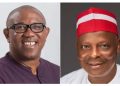
Does the platform of Peter Obi and Rabiu Kwankwaso, the Nigeria Democratic Congress (NDC), offer the much-needed opportunity to correct these mistakes? Are Northerners prepared to set personal interests aside and reshape Northern politics for the benefit of the wider society? The central question is this: why do Obi and Kwankwaso appeal to people? Both have demonstrated strong records—Obi with his “consumption to production” philosophy, and Kwankwaso through his emphasis on education, employment, and healthcare. Their tenures in Anambra and Kano states respectively, where they exercised authority, reflect their dedication to these essential areas of poverty reduction.
When Peter Obi describes Northern Nigeria’s vast landmass as the country’s future source of wealth, he also explains how that potential can be realised—by securing the region, providing employment for idle young people who may otherwise turn to crime, and supporting small businesses. His claim that Nigeria has no justification for being poor speaks directly to the region’s untapped and underdeveloped resources.
Millions of ordinary Northerners suffer under a self-serving political system. It is reasonable to conclude, without dispute, that Nigeria’s difficulties arise from elites’ political exploitation of the North’s numerical strength, as they convert religion, ethnicity, and poverty into electoral influence without using that influence to promote development. Next year’s election presents Northern voters with a significant opportunity to choose leaders capable of delivering security, education, employment, productive agriculture, and accountable governance. This explains why the Peter Obi/Rabiu Kwankwaso ticket resonates with many people in the North today. Former Vice President and the African Democratic Congress (ADC) Presidential flagbearer, Atiku Abubakar’s sentiment of being a Northerner appears not to be resonating not only because it will disrupt the zoning arrangement that is helping to stabilise the polity in the country but also because he belonged to the old brigade that had exploited the region. While he, like other Northern political leaders, has grown in wealth and fame, the region and majority of its people have been going down.
This Obi-Kwankwaso 2027 project may be the most sensible option for Northern leaders because, in a region burdened by poverty, it echoes John F. Kennedy’s warning: “Those who make peaceful revolution impossible will make violent revolution inevitable.”
People also remember Frederick Douglass’s words: “Power concedes nothing without a demand. It never did and it never will,” but the youths of the North are already demanding it.
Self-serving leaders in the North, like their counterparts in other regions within the ruling APC, who are still living in the past, appear to be overlooking the shortcomings of President Tinubu, including his questionable background, the lack of transparency surrounding his records, and the obvious corruption under his administration. The main priority of such people is enriching themselves, even when it comes at the people’s expense.
Ultimately, it is therefore necessary at this juncture, while ending this conversation, to remind those who have chosen to ignore the region’s troubling circumstances and who have continued to exploit the North of the counsel offered by South Africa’s renowned cleric, Desmond Tutu, that “If you are neutral in situations of injustice, you have chosen the side of the oppressor.” And when the time comes to hold the oppressors accountable, no one will be exempt. May God help us.
*Ike, a consummate journalist, public affairs analyst lives in Abuja