

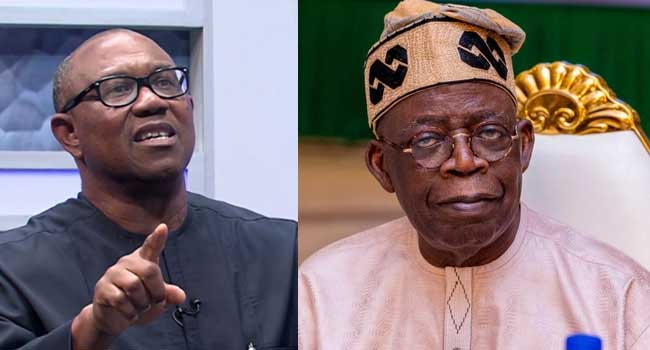
The Presidency on Monday, June 22nd, 2026 dismissed the call by the presidential candidate of the National Democratic Party (NDC), Mr Peter Obi, for President Bola Ahmed Tinubu to resign, describing the demand as childish, anti-democratic and a needless distraction from governance.
In a statement in Abuja, the Special Adviser to President on Information and Strategy, Mr Bayo Onanuga, accused Obi of drawing inappropriate comparison between Nigeria’s presidential system of government and the United Kingdom’s parliamentary system, saying the analogy was fundamentally flawed.
According to him, Nigeria operates a constitutional presidential system in which an elected president serves a fixed four-year term and cannot be pressured out of office through social media campaigns.

He said the recent electoral victories recorded by the ruling All Progressives Congress (APC) in Ekiti state and senatorial elections in Nasarawa, Enugu, Ondo and Rivers states reflected growing public support for President Tinubu and his administration.
“Obi should wait until the presidential election to know what the people think of Tinubu’s government.
“Moving to use X to harangue the President out of office is off the mark and anti-democratic,” he said.

The presidential aide also defended the administration’s handling of insecurity, insisting that President Tinubu inherited deep-rooted security challenges but has made significant progress through intensified military operations and increased investments in security infrastructure.
He said thousands of terrorists had been neutralised, numerous abducted victims rescued and advanced technologies, including drones, deployed to strengthen security operations nationwide.
He also criticised Obi’s record as former governor of Anambra state, arguing that he lacked the moral authority to question the current administration’s security efforts.
On the economy, the presidential aide rejected Obi’s assertion that Nigeria was in its worst condition, insisting that available economic indicators pointed to steady improvements since President Tinubu assumed office in May 2023.
He said the administration’s economic reforms had resulted in sustained quarterly Gross Domestic Product growth, rising foreign reserves, increased oil production and stronger government revenues.
According to him, oil production has risen from less than one million barrels per day to about 1.8 million barrels daily, while foreign reserves have exceeded $50 billion.
He also stated that federation revenue is projected to surpass N30 trillion this year, compared to N7.7 trillion recorded in 2022, adding that improved allocations have provided state governments with more resources for developmental projects.
Onanuga said investor confidence had also improved significantly, citing record levels of foreign direct and portfolio investments and substantial growth in the Nigerian stock market.
He equally highlighted infrastructure projects being undertaken by the administration, including the Lagos-Calabar Coastal Highway and the Sokoto-Badagry Super Highway, which he said were long-conceived projects now being actualised.
He also pointed to the introduction of compressed natural gas initiatives and the implementation of interest-free student loans as evidence of President Tinubu’s commitment to innovation and social welfare.
He credited the administration with maintaining uninterrupted academic calendars in tertiary institutions, noting that prolonged industrial actions by unions such as ASUU and NASU had not occurred during Tinubu’s three years in office.
Addressing criticisms over electricity supply, Onanuga accused Obi and his supporters of deliberately misrepresenting Tinubu’s campaign promises.
He said the President never guaranteed immediate 24-hour electricity nationwide but pledged to improve power supply and eliminate estimated billing.
He said that one of the administration’s earliest actions was signing the Electricity Act, which empowers states to independently generate, transmit and distribute electricity.
According to him, the government has also accelerated the deployment of prepaid meters and expanded off-grid solar power projects across schools, hospitals and markets nationwide.
He acknowledged that Nigerians continue to grapple with the high cost of living but attributed part of the challenge to global economic disruptions and geopolitical tensions, particularly developments in the Middle East affecting international supply chains.
He described Obi’s comments as political grandstanding aimed at diverting attention from the APC’s recent electoral successes.
“President Tinubu focuses on solutions, not rhetoric—investing in reforms, stabilising the economy, improving security and laying the groundwork for a more prosperous Nigeria,” he said.
The presidential aide accused Obi of operating within “self-constructed echo chambers” and promoting what he described as a distorted narrative about conditions in Nigeria.