

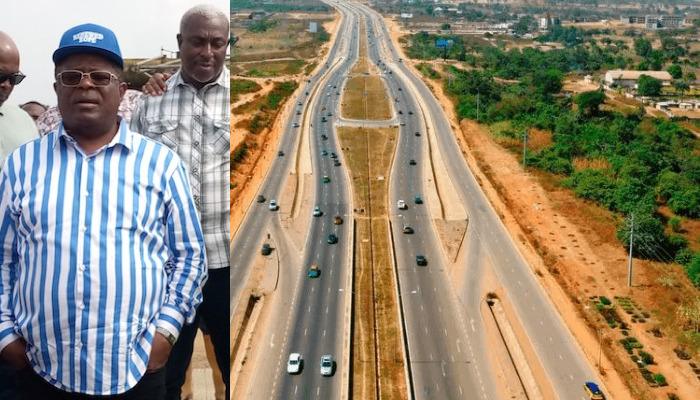
The Minister of Works, Sen. David Umahi, has described the 750-kilometre Lagos-Calabar Coastal Highway, as a profitable national investment capable of generating revenue, attracting private investors and unlocking tourism and industrial opportunities.
Umahi reaffirmed President Bola Tinubu’s commitment to completing the project, which traverses nine coastal states, insisting that the administration would not abandon the ambitious infrastructure undertaking.
The Minister spoke on Sunday, November 22, 2026, during an inspection of bridges along Sections 1 and 2 of the highway.
“Nothing will happen to the 750-kilometre Lagos-Calabar Coastal Highway, which passes through the nine coastal states. The President has directed that the project must be completed as envisaged,” he said.
Explaining the economic prospects of the project, Umahi said the adoption of concrete pavement and solar-powered infrastructure would make the highway eligible for carbon credits, while creating opportunities for private sector participation.
“We are using concrete, and so we are entitled to carbon credits claim. We are also using solar instead of conventional electricity; we are entitled to carbon credits,” he stated.

He added that the highway would accommodate tourism facilities, factories, CCTV surveillance systems and other commercial infrastructure capable of generating revenue.
The minister disclosed that President Tinubu was expected to commission Section 1 either in November or early December.
He also described the ongoing 1,068-kilometre Sokoto-Badagry Highway as another major infrastructure project of the administration.
Umahi clarified that the reconstruction of the East-West Road was an additional commitment by the President and would neither replace nor affect the Lagos-Calabar Coastal Highway.
He said the administration was simultaneously pursuing several major infrastructure projects across the country.
The minister commended Tinubu for what he described as the administration’s commitment to infrastructure development and economic reforms.
He cited declining inflation, improved foreign exchange access for businesses and the absence of industrial action by the Academic Staff Union of Universities (ASUU) as developments deserving public recognition.
He particularly appealed to Nigerians, including South-East residents living in Lagos, to support the President, arguing that the region had benefited from significant infrastructure projects under the administration.
Meanwhile, Umahi has ordered a three-week nationwide emergency rehabilitation of major federal highways ahead of the festive season and the January 2027 elections.
He directed Zonal Directors, Controllers, Resident Engineers and contractors to return to the field immediately to ensure that critical roads across the six geopolitical zones were restored to motorable conditions.
The minister warned that contractors must not allow motorists to suffer on failed sections of highways while permanent construction work was ongoing.
He directed that damaged portions be excavated and rehabilitated with appropriate materials, including asphalt where necessary.
“I feel so sad that a contractor will be on site doing permanent work, yet some sections of the roads remain impassable. This practice must stop,” he said.
Umahi further instructed ministry officials to document the rehabilitation exercise, engage contractors, promptly report challenges and ensure that affected roads were restored to acceptable conditions within the stipulated three weeks.
He explained that the intervention was designed to ease movement during the festive season, facilitate the transportation of goods and services, support the movement of election materials and strengthen security operations ahead of the 2027 general elections.
The minister urged officials of the ministry and contractors to demonstrate commitment, sacrifice and urgency in carrying out the assignment.