

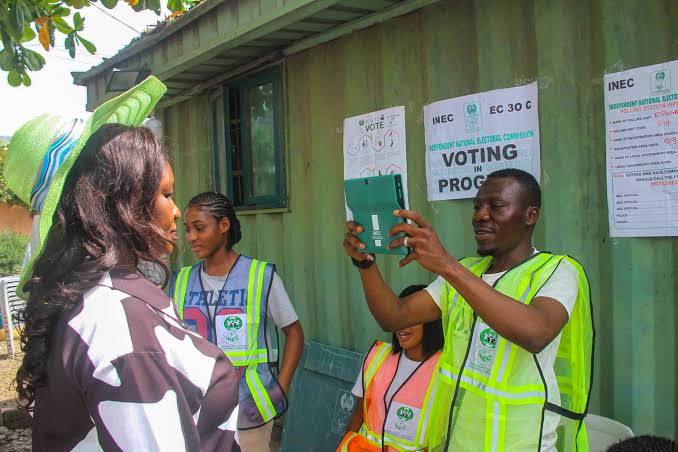
The Independent National Electoral Commission’s (INEC) nationwide mock accreditation and voting exercise ahead of the 2027 general elections has exposed operational shortcomings, including malfunctioning Bimodal Voter Accreditation System (BVAS) machines, late arrival of electoral officials, missing names on the voters’ register and widespread voter apathy.
The exercise, conducted on Saturday across 17,676 polling units nationwide, was designed to assess the commission’s technological and logistical preparedness for the forthcoming general elections.
However, reports from several states indicated that the exercise was disrupted by technical difficulties, poor public awareness and delays in the deployment of electoral personnel.

While some voters complained about difficulties with fingerprint and facial recognition, others said they could not locate their names on the voters’ register or had to wait for hours before officials arrived.
In Kaduna State, the exercise suffered setbacks in parts of Chikun Local Government Area as electoral officials failed to arrive at some polling units at the scheduled 8:30am commencement time.
READ ALSO:Mock election impressive, INEC ready for 2027 polls, Amupitan declares

At Narayi LGEA Primary School, a voter, Gimbiya James, said she waited for about two hours without seeing any INEC official.
“According to INEC, they are supposed to start this exercise by 8:30am. But we didn’t see any official as of around 10:30am. This is really disheartening,” she said, adding that some voters had left out of frustration.
Another voter at Ungwan Yelwa Primary School, Obadiah Bako, said he arrived at 7:30am but could not find any electoral official as of 11am.
“We have been here actually since 7:30, and there is nobody on ground. The whole place is scanty,” he said.
Ondo State also recorded poor participation, alongside reports of BVAS malfunctions in some polling units in Akure. At Polling Unit 46, Ward 2, only two of the 470 registered voters participated, while 11 out of 940 registered voters turned up at Unit 11, Ward 5.
A voter, Ebenezer Oni, said he abandoned the exercise after waiting for hours because the accreditation machine was not functioning properly.
“I had to go back home after waiting for some hours at the unit, and the machine (BVAS) did not function properly. I lost interest because I know it is not a real election. I will advise INEC to work on this challenge, so that the 2027 election would be free and fair,” he said.
In Kano State, while officials reported smooth operations in some locations, technical problems were recorded elsewhere. A Presiding Officer at Chediya Uku Polling Unit 004 in Nasarawa Local Government Area, Dahiru Dan-Sarki, said the BVAS displayed an incorrect password.
Similarly, low participation was recorded in Niger, Benue, Kogi, Borno, Jigawa, Yobe and Sokoto states. In Benue, for instance, only 11 of 754 registered voters were accredited at Madikpo Tokunbo Market polling unit, while six participated at LGEA Primary School, Wurukum.
INEC officials in Benue attributed some complaints about missing names to delays in the distribution of Permanent Voter Cards, particularly among residents who registered in June and July. The commission said PVC distribution would take place between December 1 and 7.
In Jigawa, some voters also complained that their names were missing from the registers at polling units they visited, raising concerns about changes in polling unit locations and inadequate public communication.
The situation was not significantly different in parts of the South-West and South-South, where poor turnout and inadequate mobilisation affected participation.
Several polling centres in Ibadan, Oyo State, recorded limited participation, with some locations deserted and electoral officials absent at one of the centres visited.
An INEC official expressed disappointment over the response, saying personnel were ready but had few voters to attend to.
“We have been here waiting for people to come forward for the exercise, but the response has been poor. We expected more residents to participate, considering the importance of the exercise ahead of the 2027 elections,” the official said.
In Osun State, residents blamed the low turnout on insufficient publicity, although INEC’s Public Relations Officer, Musa Olurode, said participation improved before noon, with some polling units recording between 35 and 40 voters.
Ogun State also witnessed limited participation despite assurances by the Resident Electoral Commissioner, Feyijimi Shasheyi, that the BVAS machines operated without technical difficulties at the centres monitored.
In Delta State, some polling units in Asaba recorded poor turnout, while electoral officials were reportedly absent at Government Model Secondary School, GRA, when correspondents visited.
The APC Chairman in Ward 07, Oshimili South, Okocha Patrick, blamed the situation partly on a last-minute change of polling unit, which he said disrupted preparations and voter mobilisation.
In Edo State, the exercise proceeded peacefully at the polling units visited, although participation remained low. At Garrick Memorial School in Benin City, only 20 voters participated across two polling units.
Abia State also experienced poor attendance, which the Resident Electoral Commissioner, Prof Sylvia Agu, attributed to voter apathy.
“The attendance was poor, a kind of apathy on the part of the citizens. But it was peaceful. Everything went on well. The only thing is that the attendance was very poor,” she said.
In Rivers State, participants complained about delays in the arrival of electoral personnel and materials. Nevertheless, the BVAS machines reportedly functioned satisfactorily at the centres monitored.
The Convener of the Rivers Peace Initiative, Obinna Ebogidi, commended the integration of the BVAS with the electronic Form EC8A result sheet, noting that the technology could strengthen transparency and minimise result manipulation if properly deployed.
Meanwhile, Nasarawa State Governor, Abdullahi Sule, praised INEC’s preparations, saying his accreditation and voting were completed in less than two minutes.
The Lagos State Resident Electoral Commissioner, Ayobami Salami, also expressed satisfaction with the performance of the BVAS, saying accreditation took less than a minute per voter at the centres monitored.
“I have been very impressed with what we have seen. It takes less than one minute to accredit a voter, and everything has gone seamlessly. So far, there has been no complaint from our personnel, members of the public or voters,” he said.
However, the Executive Chairman of Surulere Local Government, Bamidele Yusuf, questioned the adequacy of selecting only two polling units per ward for the exercise, arguing that such a sample might not provide a comprehensive assessment of INEC’s readiness.
Despite the challenges reported across several states, INEC Chairman, Prof Joash Amupitan, expressed satisfaction with improvements in fingerprint authentication and facial recognition during the exercise in Plateau State.
He recalled that the commission had experienced difficulties with fingerprint verification during previous off-cycle elections but said the latest test showed considerable improvement.
“We are rehearsing to ensure that our tools are working well. In the off-cycle election, when we conducted a mock accreditation, we discovered that it was virtually almost impossible to verify through the first line of verification, which is the fingerprints.
“But today, I have seen a great improvement in the sense that a lot of people were able to get accredited using the fingerprints,” he said.
Amupitan explained that voters whose fingerprints could not be authenticated were processed through facial recognition.
He added that the exercise also tested vote counting, completion of result sheets and electronic transmission of results.
The INEC chairman said the commission had made provisions for persons with disabilities, including assistive materials such as magnifying glasses and Braille ballots. He also disclosed that designated voting locations had been identified for internally displaced persons.
He assured Nigerians that the observations from the mock exercise would guide further improvements in the commission’s technological and operational preparations for the 2027 general elections. (PUNCH)