

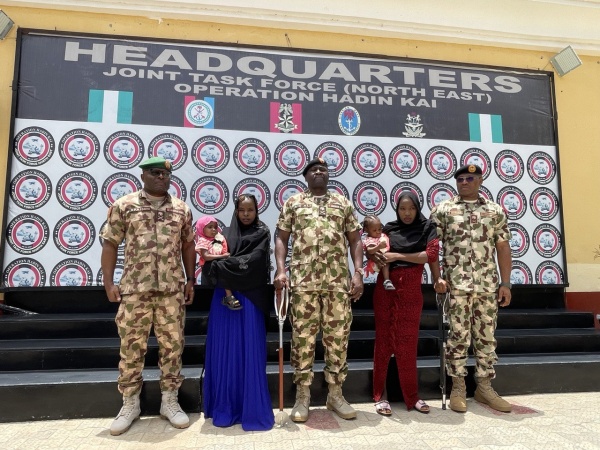
Two Chibok schoolgirls abducted in 2014 have reportedly regained their freedom after more than 12 years in captivity, with one of the survivors emerging with two children fathered by Boko Haram fighters she said she was forced to marry.
The latest escape comes days after Deborah Ishaya, one of the Chibok girls relocated to the United States by Washington-based international human rights lawyer Emmanuel Ogebe, got married in America.
Ogebe, who disclosed the latest development in an e-mail to News Express, said he was delighted by the return of the girls, describing the escape of Jinkai Yama, about 12 and a half years after the mass abduction, as a victory over terrorism and despair.

According to him, Yama disclosed that she had been married to eight terrorists during her captivity and had two children. He said another Chibok escapee whose identity was not disclosed also returned with children.
“Jinkai Yama’s escape 12 and a half years after the 2014 atrocity is a triumph of hope and the human spirit over terror, evil and despair,” Ogebe said.
He noted that Yama’s escape occurred shortly after the wedding of Ishaya, whom he described as one of the Chibok girls he sponsored to the United States following their escape from captivity.

Ogebe said Ishaya and another Chibok survivor became the first among the girls to graduate from an American high school with diplomas in 2017.
He added that Ishaya had graduated with multiple honours and awards from an international high school in the Washington, D.C. region before subsequently completing her higher education.
According to Ogebe, four of the Chibok girls he relocated to the United States have now married, while they have also completed degree and, in some cases, master’s programmes.
He contrasted their experiences in the United States with Yama’s reported captivity, saying the circumstances surrounding her forced marriages demonstrated the loss of free will suffered by girls held by Boko Haram.
Ogebe said Yama’s escape also raised questions about the continued captivity of Chibok girls and the circumstances surrounding her forced marriages demonstrated the loss of free will suffered by girls held by Boko Haram.
Ogebe said Yama’s escape also raised questions about the continued captivity of Chibok girls and the circumstances surrounding their eventual recovery.
He said Yama reportedly identified the location of her latest husband in Gwoza, an area associated with Boko Haram’s long-running insurgency, and questioned why the Nigerian authorities had not been able to fully secure the area.
He also expressed concern that Yama had reportedly not spoken to her family and did not know whether they were still alive.
Ogebe urged the government to facilitate her reunion with her family, saying she had spoken about thinking about them throughout her captivity and wanting their guidance on whether to return to school.
He argued that her escape contradicted claims that some of the abducted girls did not want to return home.
“Jinkai’s escape also debunks spurious claims that the girls do not wish to return,” he said.
Ogebe also challenged claims contained in the 2023 book, The Sisterhood: The Secret History of Women at the CIA, which alleged that the US Central Intelligence Agency and other Western agencies had helped recover 30 Chibok girls from Sambisa Forest.
According to Ogebe, the account gave the impression that some girls had been reached but chose to remain in captivity because they had been married to fighters or had children.
He said he had previously challenged the account and disputed the claim that 30 girls had been rescued at one time, citing the separate releases of 21 girls in 2016 and 82 in 2017.
He said the continued escape of Chibok survivors more than a decade after their abduction reinforced the need to continue efforts to locate and recover those still missing.
“The very fact that Jinkai and others are still escaping a dozen years later disproves claims that they never wanted to return,” Ogebe said.
He commended the Nigerian Army for facilitating the recovery of the latest survivors and other victims of terrorism.
The Chibok schoolgirls were abducted from their school in Borno State in April 2014 by Boko Haram, an incident that triggered the global #Bring Back Ourgirls campaign and renewed international pressure on Nigeria to rescue the victims.