

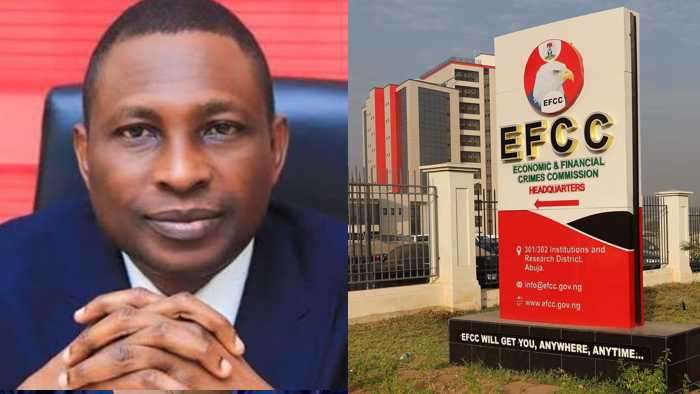
The Economic and Financial Crimes Commission (EFCC), has claimed that the fight against corruption is no longer just about jailing politicians.
According to the commission, “it is about money in schools, credit in homes, and Nigeria’s name back on the global financial map”.
Rendering account of his 34 months in office, the Executive Chairman of EFCC, Ola Olukoyede, told journalists in Abuja on Monday that the Commission secured 10,872 convictions from 14,476 cases filed — a conviction rate of 75.1 per cent — and recovered more than ₦1.2 trillion in cash and assets.

According to the EFCC Chairman, “the past 34 months have been a period of sustained enforcement, institutional reform, prosecution, asset recovery, restitution and stronger collaboration.
“Between October 2023 and July 2026, the Commission received 49,673 petitions and investigated 39,615 cases.
“Cybercrime and advance fee fraud dominated the threat landscape, making up nearly two-thirds of the 46,288 offences recorded”.

However, Olukoyede noted a 24.1% jump in procurement fraud, bank fraud and economic-governance offences between 2024 and 2025.
“We are protecting citizens, businesses and institutions from fraud, cyber-enabled crime and other forms of economic exploitation. The fight is not only about grand corruption,” he stated.
The EFCC Chairman said he went after big names, including former Minister Saleh Mamman; former NSITF MD, Robert Orya, and former Director in the AGF’s office, Chukwunyere Nwabuoku.
“The principle is simple: no office or title places anyone beyond the reach of the law,” he said.
According to him, the Commission recovered a total sum of ₦1,233,612,040,411.11, $684.4 million, £373,905.78 and €9.3 million.
Olukoyede stressed restitution arising from court judgements amounted to ₦661.32 billion and $492.37 million, released directly to the beneficiaries.
“Two-thirds of naira recoveries, ₦836.34 billion, went to MDAs, state revenue services, companies and individual victims — not the Federal Government.
“The fiscal impact was direct. Federal and state tax recoveries hit ₦288.1 billion. Another ₦257.2 billion was recovered for MDAs.
“Most dramatically, proceeds of crime were converted into social programs. ₦100 billion from EFCC recoveries was allocated to NELFUND and the Nigerian Consumer Credit Corporation in 2024, with another ₦100 billion approved in 2026.
“A forfeited private asset, NOK University, was converted to the Federal University of Applied Sciences, Kachia.
“1,909 students matriculated in December 2025 at the University. These are students who ordinarily would not have been afforded the opportunity of tertiary education,” Olukoyede said.
The Chairman linked EFCC’s achievements to Nigeria’s exit from the FATF Grey List in October 2025, describing the development as “a national achievement.”
He added that crackdowns on 234 unlicensed BDCs with 73 convictions were also credited with supporting CBN reforms and stabilizing the forex market.
“Internationally, the EFCC deepened ties with the FBI, UK’s NCA, RCMP and INTERPO,” which culminated in. Olukoyede being re-elected as President of NACIWA, the network of West African anti-corruption agencies.
On reforms withing the Commission, Olukoyede said they have digitalized nearly 60% of their processes and opened new directorates in Ekiti, Anambra and Katsina.
It also launched the Cybercrime Rapid Response Centre, E-C2R2, and an EFCC Radio station, adding that new guidelines on arrest, bail and sting operations were introduced.
“The Internal Affairs Department was renamed Ethics and Integrity Department to reflect our commitment to internal cleansing,” he said.
Olukoyede said the focus of the Commission now shifts to prevention, faster restitution, and better technology.
“We are not merely counting arrests or announcing recoveries. Our responsibility is to convert recoveries into restitution, and enforcement into measurable national value,” he stressed.