

By Sam Otuonye
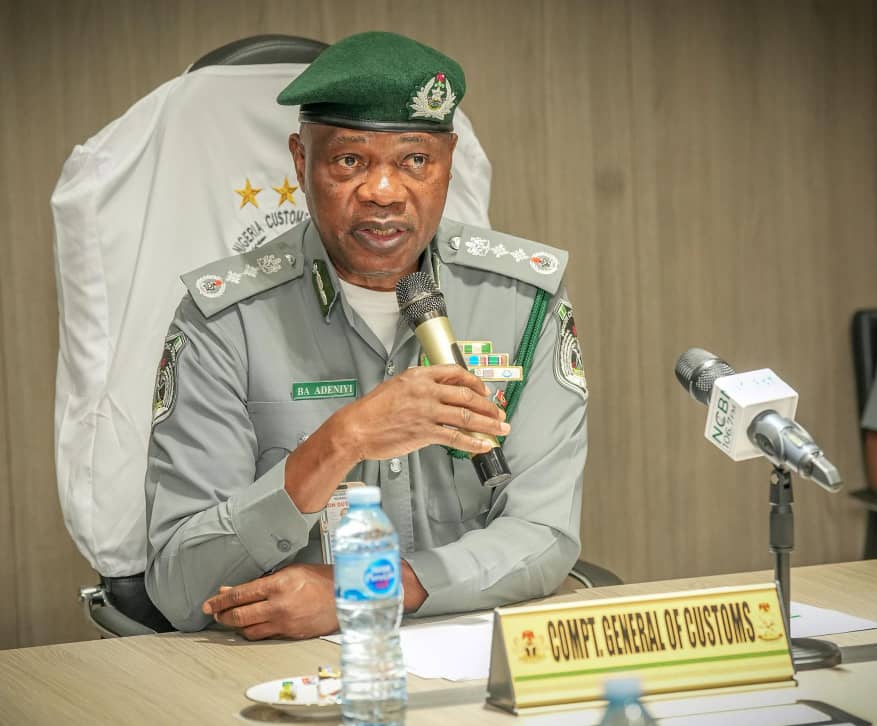
When Bashir Adewale Adeniyi assumed office as Comptroller-General of the Nigeria Customs Service, the agency was facing a familiar dilemma: how to collect more revenue without making legitimate trade more difficult.
Three years into his leadership, the numbers suggest that Adeniyi has made significant progress on the revenue side. But the bigger question is whether the same reforms are sufficiently transforming Customs from a revenue-collection agency into an institution that genuinely facilitates trade and adds value to the Nigerian economy.
In 2024, Customs collected a record N6.1 trillion, exceeding its N5.08 trillion target by more than N1 trillion. In 2025, the figure rose further to N7.281 trillion, beating the approved target of N6.584 trillion by N697 billion, or about 10.24 per cent. Compared with 2024, the increase was approximately N1.18 trillion, representing about 19 per cent growth.
These are not small numbers. They show that Adeniyi’s reforms have strengthened Customs’ capacity to collect revenue.
*Trade facilitation – The Adeniyi’s approach

Adeniyi has changed the philosophy of Customs administration by combining enforcement with technology, risk management, stakeholder engagement and faster processing for compliant businesses.
One of his most visible reforms is the Unified Customs Management System, popularly known as ‘B’Odogwu’.
The idea behind B’Odogwu is to reduce dependence on manual procedures, bring customs processes onto a digital platform, improve transparency and make it easier to monitor transactions.
This is important because every unnecessary manual stage in cargo clearance creates room for delay, error and possible abuse.
The reform is already producing measurable results in revenue collection. In the first six months of 2025, Customs collected about N3.643 trillion, exceeding its half-year projection by N390.2 billion, or 11.85 per cent. The Service said the performance reflected improved compliance and increased deployment of technology.
The significance is not merely that Customs collected more money. It suggests that better administration can increase revenue without necessarily increasing the tax burden or import volume.
*The Authorised Economic Operator experiment
Perhaps Adeniyi’s most important trade-facilitation initiative is the Authorised Economic Operator, or AEO, programme.
The principle is simple: businesses with a record of compliance should not be treated like suspected smugglers.
Instead, trusted companies should receive faster processing and fewer unnecessary physical interventions.
The early figures are encouraging.
By October 2025, 51 companies participating in the AEO programme had generated N1.585 trillion in Customs revenue, compared with N1.222 trillion before their certification. That represented an increase of about N362 billion, or 29.68 per cent.
This is perhaps one of the clearest examples of Adeniyi’s argument that facilitation and revenue collection are not necessarily opposites.
The old thinking often assumes that stricter Customs controls automatically produce more revenue. Adeniyi’s experiment suggests that rewarding compliance can also improve revenue.
If a compliant importer can clear cargo faster, the importer saves time and money; the port becomes less congested; Customs spends less time examining low-risk cargo; and government still collects its lawful revenue. That is the economics of smart Customs administration.
*Six scanners and the technology question
Adeniyi has also pushed the Service towards non-intrusive inspection.
By 2025, Customs reported the arrival of six scanners, including an FS6000 model, alongside the development of an Electronic Cargo Tracking System and a Centralised Image Tracking System.
This is significant as physical examination of containers is slow, expensive and potentially disruptive. Modern scanners allow Customs officers to examine cargo without necessarily opening every container and this simultaneously improve security and facilitate trade.
*Fighting smuggling without suffocating trade
Adeniyi has maintained an aggressive enforcement posture.
In 2025, Customs recorded more than 2,500 seizures with an estimated aggregate value exceeding N59 billion. The seizures included narcotics, counterfeit pharmaceuticals, arms and ammunition, petroleum products, wildlife products and substandard goods.
These operations have an obvious economic and security value.
Counterfeit medicines threaten lives. Smuggled petroleum products undermine the formal economy. Illegal arms can feed insecurity. Wildlife trafficking damages Nigeria’s environmental resources.
*Building trust with the business community
An efficient customs administration also requires trust between government and the private sector.
Importers, exporters, manufacturers and customs agents need to understand the rules and know that those rules will be applied fairly.
Frequent changes in procedures, unclear interpretations and inconsistent enforcement can create uncertainty.
The NCS under Adeniyi has increasingly emphasised engagement with stakeholders. Such engagement is useful because customs officers may understand enforcement challenges while businesses understand the practical difficulties encountered during the movement of cargo.
*Human Capital Development
CGC Bashir Adewale Adeniyi has made human capital development a central pillar of his administration’s modernization and reform agenda.
Adeniyi treats staff training as an operational necessity rather than an option, aiming to shift mindsets and expose personnel to both local and international best practices. Beyond internal workforce training, his administration launched initiatives like the Customs Cares program to support the wider education sector and community development.
*Recognition and Awards
Industrial Training Fund (ITF) Honors: The ITF recognized CGC Adeniyi for outstanding human capital development, citing his deliberate strategy to train officers across all ranks to drive service performance.
His emphasis on modernization and capacity development also extends internationally, aligning with his role as Chairperson of the World Customs Organization (WCO) Council.
*Measuring the real Adeniyi legacy
The ultimate test of any Customs administration should not be the number of seizures made or the amount of revenue collected alone.
Those figures are important, but they tell only part of the story.
The bigger questions are: How long does it take to clear legitimate cargo? Has the cost of importing and exporting reduced? Are businesses finding the system more predictable? Has corruption reduced? Are Nigerian manufacturers becoming more competitive? Is more Nigerian produce being exported? Is technology improving transparency?
These questions have been addressed by CGC Adeniyi’s administration, for greater value and economic growth while retaining its enforcement responsibilities.
No wonder, President Bola Tinubu in June 2026 approved a final six-month tenure extension for Adewale Adeniyi, against his August 1 retirement date, to enable him complete key reforms within the Customs Service, while paving the way for a smooth leadership transition. By the extension, he will remain in office until February 2027.