

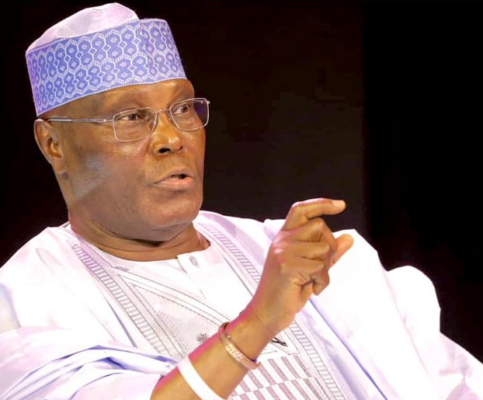
*Says, my position remains in tact
The presidential candidate of the African Democratic Congress, Atiku Abubakar, has insisted that his position on fuel subsidy has not changed, declaring that he will restore the policy if elected president in 2027.
Atiku’s rebuttal was made on Tuesday via his official X on a day he received the Osun State leadership of the ADC in Abuja.
Writing on X, Atiku disowned the comments made by his principal media aides, Mazi Paul Ibe, during an interview on AIT, stressing that Ibe was not speaking on his authority.
“Earlier, one of my press aides contradicted me in a policy statement as far as subsidy is concerned.
“I want to repeat categorically that when I said I would return to subsidy, I will! Nigeria is rich enough to look after the welfare of its citizens. Let it be clearly stated that he was not speaking on my own authority,” Atiku said.
Ibe had earlier said in his interview that his principal would restore petrol subsidy if elected president in 2027, but would gradually phase out the intervention after the economy recovers.

Atiku, on his X account, countered the position, insisting that his stance on the issue remained unchanged.
“On the question of subsidy, my position has not changed and will not change: I will restore it! A nation as blessed as ours has no business abandoning its citizens to hardship. Nigeria is rich enough to look after her own.
“I believe the wealth of a nation is not measured by how much government collects, but by how much the money in the pockets of its people can buy.
“I want wages to have value again. I want farmers to move produce without transport swallowing their profits. I want families to fill their baskets without emptying their pockets. I want businesses to produce, employ and prosper.
“That is why I will restore targeted subsidy and put purchasing power back in the hands of Nigerians.
“When fuel rises, transport rises. When transport rises, food rises. When food rises, families suffer. I will break that wretched chain that has defined our national life in the nearly four years of Tinubu’s presidency.
“I will support Nigerian production, reduce energy costs and restore purchasing power. I will not restore the import racket; I will restore relief.
“I restated this commitment when I received the Osun State leadership of the ADC in Abuja on Tuesday.
“I will make the naira in your pocket worth more, make daily living affordable again, and secure our people. That is the Nigeria I intend to build.”
Atiku also drew a clear distinction between his proposed petroleum intervention and Nigeria’s former fuel import subsidy regime, saying any support under his administration would be targeted at domestic production and tied to measurable performance.
In a statement issued on Tuesday by his Senior Special Assistant on Public Communication, Phrank Shaibu, the former Vice-President’s camp said Atiku had not proposed bringing back the old system under which government subsidised imported petrol, but rather a capped and transparent intervention designed to support local refining, increase supply and ultimately bring down energy costs.
“For the avoidance of doubt, policy belongs to the candidate, not the spokesperson.
“Our responsibility as communicators is to explain Atiku’s position accurately, not create formulations capable of confusing Nigerians or handing opponents convenient talking points,” Shaibu said.
According to him, Atiku’s proposal would involve a “targeted, capped, transparently budgeted and independently audited subsidy” for domestic refining and production.
The intervention, he added, would not operate according to an arbitrary withdrawal date.
Instead, it would be phased out as domestic refining capacity expands, fuel supply becomes more stable and competition improves.
“There is no arbitrary withdrawal date. As domestic refining expands, supply stabilises, competition deepens, and the market becomes capable of delivering affordable prices without government support, the intervention progressively becomes unnecessary,” he added.
Shaibu likened the proposed arrangement to temporary scaffolding used during construction.
“You do not remove scaffolding because the calendar says so. You remove it when the building can stand securely on its own,” he said.
The clarification comes as the fuel subsidy debate has returned to the centre of the 2027 presidential contest.
President Bola Tinubu abolished the petrol subsidy at his inauguration on May 29, 2023, a decision that triggered a sharp increase in petrol prices and fed into a broader cost-of-living crisis.
The reform, alongside the liberalisation of the foreign exchange market, has also been defended by the Federal Government as necessary to strengthen public finances and attract investment.
The subsidy question has nevertheless remained politically sensitive because of its direct impact on transport, food prices, household expenses and the operating costs of businesses.
Atiku reignited the debate last week when he said he would bring back the petroleum subsidy if elected, arguing that Nigerians had not benefited sufficiently from the savings associated with its removal.
His latest clarification seeks to redefine that position as a production-support mechanism rather than a return to the old import-driven arrangement.
The ADC presidential candidate said any intervention would be subject to controls intended to prevent the leakages associated with the former subsidy regime.
Rather than focusing on when government support would end, Shaibu said the emphasis should be on whether the intervention achieves its intended economic objectives.
“The real question is simple: Why has everything become so expensive, and what will Atiku do to make life affordable again?” he asked.
He accused the Tinubu administration of transferring the burden of its economic reforms to households and businesses, arguing that an Atiku government would instead focus on reducing production and transportation costs, strengthening domestic refining and rebuilding purchasing power.
“Tinubu transferred the shock of his reforms to Nigerian families.
“Atiku will reduce production and transportation costs, strengthen domestic refining, and restore purchasing power.
“The choice is not removal of subsidy versus restoration of subsidy. It is Expensive Nigeria versus Affordable Nigeria,” Shaibu said.