


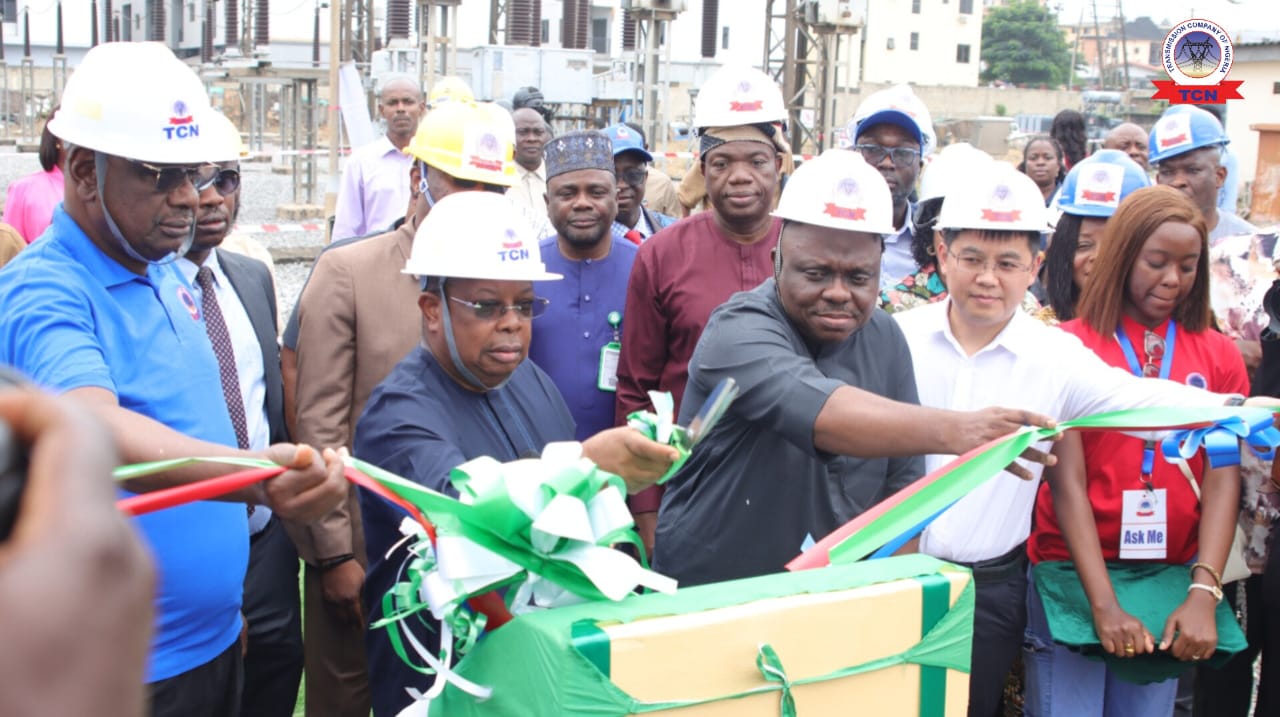
The Federal Government has commissioned a new 100MVA, 132/33kV power transformer at the Alausa Transmission Substation in Lagos State, raising the facility’s installed capacity from 135MVA to 205MVA.
The Minister of Power, Joseph Tegbe, who commissioned the transformer on Tuesday, said the project was part of ongoing efforts by the Federal Government to expand transmission capacity and ease electricity supply constraints in critical economic areas.
Tegbe said the upgrade would increase the quantum of bulk electricity available to the Ikeja Electricity Distribution Company (IKEDC) by 80MW for onward distribution to consumers across its franchise area.

He described Alausa as a strategic economic and administrative hub in Lagos, noting that the area hosts government offices, businesses, industries, residential communities, hospitals, schools and other establishments that depend heavily on reliable electricity.
According to him, the new transformer replaces the existing 30MVA unit at the substation, increasing the capacity of that transformer position by 70MVA.
Before the upgrade, the substation had one 60MVA, one 45MVA and one 30MVA transformer, with a combined capacity of 135MVA, equivalent to about 108MW.

With the installation of the new 100MVA unit, the total installed capacity has risen to 205MVA, representing approximately 164MW.
“More importantly, it has increased the quantum of bulk power available to IKEDC by 80MW for onward delivery to consumers within its franchise area,” Tegbe said.
The minister said the project would have wider economic benefits by improving electricity availability for businesses, industries and households in the area.
He said the Federal Government’s strategy was to identify transmission bottlenecks, invest in critical infrastructure, remove constraints and unlock additional capacity across the electricity value chain.
Tegbe added that the government would continue to expand substations requiring additional capacity, rehabilitate ageing equipment and prioritise investments in locations experiencing increased industrial and commercial demand.
He commended the Transmission Company of Nigeria (TCN) for delivering the project and acknowledged the contribution of the Nigerian Independent System Operator (NISO) to the coordinated and efficient operation of the power system.
The minister also urged IKEDC to ensure that the additional bulk power capacity translates into improved electricity supply for consumers.
He commended Shanghai Electric Group Company Limited, which executed the project, as well as the World Bank and other technical and development partners involved in the intervention.
Earlier, the Managing Director and Chief Executive Officer of TCN, Engr. Sule Ahmed Abdulaziz, said the project represented another milestone in efforts to strengthen Nigeria’s transmission network.
Abdulaziz said the 100MVA transformer replaced the existing 30MVA unit and increased the overall capacity of the Alausa substation from 135MVA to 205MVA.
He disclosed that the project was executed by Shanghai Electric Ltd under a World Bank-funded programme that commenced in January 2021.
According to him, although the project encountered implementation challenges, TCN remained committed to completing the critical infrastructure.
Abdulaziz said the transformer would provide more stable and reliable electricity to at least 70,000 residents in Alausa and surrounding communities through IKEDC.
He added that the upgrade would also enable TCN to wheel more bulk power to distribution load centres, strengthening grid stability and improving electricity delivery to consumers.
The TCN chief said the project was consistent with President Bola Ahmed Tinubu’s Renewed Hope Agenda and the Federal Government’s broader efforts to systematically improve the power sector.
Tegbe subsequently commissioned the 1x100MVA, 132/33kV transformer and its associated facilities on behalf of President Tinubu and the Federal Government.
The Alausa project forms part of a wider programme of transmission infrastructure upgrades aimed at expanding wheeling capacity, improving grid stability and increasing the availability of bulk electricity to distribution companies nationwide.