

The rumour spread fast last Thursday: “America has packed up and left Nigeria”, but Defence Headquarters debunked the information as untrue.
In a firm clarification on Friday, the DHQ drew a clear line between two different US deployments — and confirmed that 200 American troops are still on Nigerian soil, working side-by-side with Nigerian forces on intelligence and technical training to crush ISIS and other terror networks.
A foreign news agency had set off alarm bells after quoting the Commander of US Air Forces in Africa, General Dagvin R.M. Anderson.

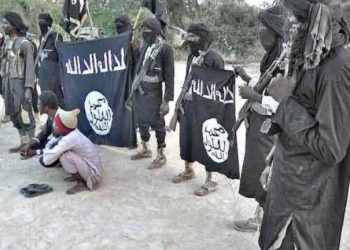
He told a virtual briefing at the African Chiefs of Defence Conference 2026 that the US had “withdrawn much of our forces” from the Lake Chad Basin following a successful operation that reportedly took out ISIS’s number two leader, Al Manuki.
To many, it sounded like a full exit.
However, according to Major-General Samaila Uba, Director of Defence Information, General Anderson was only talking about extra troops sent in for a specific Lake Chad mission.

“The Commander was primarily talking about the additional forces that came to execute the mission in Lake Chad.
“Initial US personnel are still in Nigeria,” he clarified.
He stressed that the core Nigeria-US partnership has not changed not been modified.
“The partnership between Nigeria and the US is unchanged with key information sharing on-going,” he affirmed.
General Uba explained that sometimes, Washington sends in short-term reinforcements for targeted operations and withdraws same at the conclusion of the operation.
“As we saw in May, there are times that require additional forces to execute specific missions. Those forces are intended for short periods of time only,” he stressed.
Yet, General Anderson himself had said which sparked off the rumour: “Yes, most of the troops deployed for the Lake Chad strike have gone home. But the intelligence pipeline is still open — and it’s working.
“And so, we have withdrawn much of our forces that were just there for that operation, but are continuing the partnership that Nigeria has asked for to help continue with the intelligence sharing,” Anderson said.
He praised Nigeria as “a very capable and large country” with “a very capable military,” and credited joint intelligence work for a major win: the elimination of the second-highest-ranking figure in the global ISIS network — a man responsible for ISIS media, recruitment, and global operations.
“That operation in the Lake Chad Basin of Nigeria not only helped the countries in that immediate region; it also helps countries globally as that disrupts the ISIS network,” he added.
For now, the 200 US personnel embedded in Nigeria remain focused on training and intelligence. And if new threats emerge, more help could arrive quickly.
“Nigeria and US continue to work closely together to disrupt and eliminate shared threats and that remains unchanged.
“It should therefore be noted that going forward where the need arises for peculiar competencies, personnel and resources, it would be provided,” Gen. Uba stressed.