

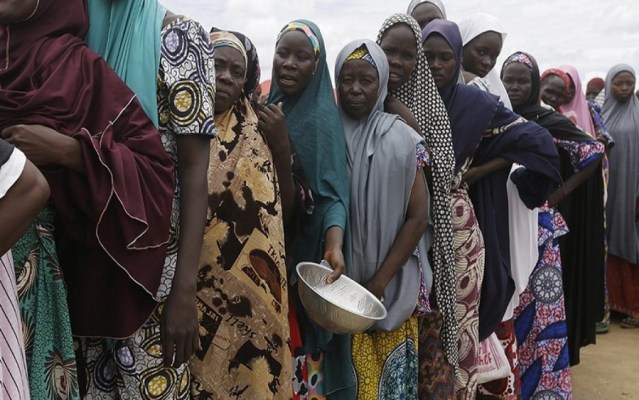
Beggars have taken over different parts of the FCT, harassing residents and pedestrians for alms. While others display ailments like cancerous breasts, swollen legs and open wounds, others are hale and hearty, but have taken to begging as a means of livelihood; PAUL OKAH reports.
Any resident or visitor to the Federal Capital Territory (FCT) is faced with the discouraging sights of beggars knocking on car windows at traffic junctions, tugging at clothes of passersby or calling out to pedestrians for alms at every turn in the FCT.
There is an interesting dimension to this development. For instance, Blueprint Weekend observed that the majority of the beggars, especially young ladies and elderly women, are hale and hearty. They often harass pedestrians, begging for transportation fare to nowhere in particular or money to eat at different intersections, including bus stops, junctions and roundabouts.

At pedestrian bridges, beggars also pose as an eyesore by dangling or displaying open wounds like infected breasts (for cancerous women), leg ulcers, amputated legs, among others, in attempts to attract the pity of pedestrians for alms.
Even in market places, shoppers are not spared harassment as different beggars position themselves at strategic points to solicit for alms, while those who are blind take to singing as they move from one shop to another, begging both traders and customers for financial assistance.
‘Sick people should be in the hospital’

Speaking with our reporter, a civil servant, Mrs. Joy Pelumi, said the beggars refused going to the hospital, preferring the money they get from givers to seeking adequate medical attention.
She said: “It’s a pity that people use sicknesses as an avenue to beg. It’s indeed an eyesore to be using a pedestrian bridge and see people displaying all sorts of illnesses in order to attract pity. You will see them on top and under the bridges at Gwarinpa, Kubwa, Dei Dei, Katampe, Mpape, Lugbe, among others.
“I once came upon a woman whose left breast was cut off at Gwarinpa Bridge. You needed to see the eyesore as she displayed her breasts in a bid to attract pity. She uses her condition as an opportunity to beg for alms from pedestrians. To make the situation worse, she was carrying a tiny baby of about three to four years. There’s also another beggar who has a leg ulcer, with flies perching on them.
“The most annoying thing is that they will refuse to take them to the hospital. Sick people should be in the hospital, not in areas where they will inconvenience others. It’s not good. The authorities concerned should look into the menace as it’s getting out of hand.”
Many beggars are lazy – Idoko
On his part, a businessman, Innocent Idoko, said the beggars have seen begging as an occupation, and that some of them even take to insulting anyone who refuses to give them money, saying they’re too lazy to work.
“I hardly give money to beggars because I consider many of them very lazy. Why can’t they engage in legitimate ventures other than begging? Some incapacitated people still engage in meaningful ventures and respectable occupations.
“Imagine dropping from a car at Banex Bridge or Berger Roundabout and your first sight is different people asking you for money to eat or to transport them to nowhere in particular,” he said.
He said further that, “Whether at Mpape Junction or Tipper Garage in Dutse, once you alight from a car, keke or okada, the beggars will besiege you with expectant greetings that’s not from the heart. It’s all in a bid to get money from you. Even if you don’t have a little denomination or change to spare, they’ll tell you they have change, and ask how much you want to give them. So, begging is really a business for them.
He lamented about some situations that, saying, “If they beg you and you don’t give them, they resort to mocking you or even insulting you, starting from what you are putting on to how you walk. You’ll see a supposed crippled beggar making derogatory remarks about someone that didn’t give him money upon request. Indeed, they constitute a nuisance that should be tackled by the FCT authorities as soon as possible.”
‘It seems people’re imported into FCT to beg’
However, a public affairs analyst, Raphael Nnamdi, claimed that economic hardship is the major reason many people have taken to begging as an occupation.
Nnamdi said: “Begging has always been the oldest profession in the country, but that of the FCT is getting worse by the day. It seems many people are imported into the FCT, just to beg at different corners. However, it’s actually a reflection of the economic hardship being faced by the citizens of this country.
“Apart from the beggars you will see along the road, we have corporate beggars even in offices. Things are getting worse and tougher for people by the day. People can hardly feed like before. This is why you see people begging under different guises.
“Those who are into businesses are finding it difficult to make ends meet, while those who are working can hardly boast of their salaries and allowances being enough to take them home. So, a combination of many factors is the reason many people have taken to begging, even if they may be hale and hearty.”
He noted that, “Even if you give someone money as a beggar, it can never be enough to solve his or her problems. This is why you will see the same person returning to the occupation, because it’s now a means of survival. So, it’s a pathetic situation we’ve found ourselves in this country. It didn’t start with this present administration. So, here we are today, hoping things will get better,” he said.
Govt should prioritise citizens’ welfare – Abdullahi
Meanwhile, a governance expert, Ahmed Abdullahi, said that the government should look into policies that will improve the welfare of Nigerians, saying many beggars are not fond of indulging in the act.
He said: “It was Jeremy Bentham who propounded the principle of ‘utilitarianism, hedonism and hedonistic calculus,’ which means the promotion of the greatest happiness of the greatest number of people. Trustfully, the government cannot touch or reach everyone, but there will be so much happiness if the government can prioritise the promotion of the welfare of the greatest number of people.
“Begging is not only in the FCT, it’s everywhere. That it’s prominent in the FCT is because it’s the seat of power. Beggars find it lucrative. If you go to the National Mosque and even many mosques at that, you’ll see them there. If you go to the entrance of churches, you’ll see beggars there. If you even go to general hospitals, you’ll still see beggars begging for money for medical bills. So, they’re just everywhere in the FCT and other states.”
He stressed that, “What the government should do is to initiate actionable policies that will lift people from poverty as it is the root cause of the growing menace of beggars in the FCT and other places. If N100,000 cannot sustain a family of four or five for a week, how can N70,000 minimum wage sustain a family for a month? Feeding is a necessity. That’s why many people beg to eat and stay alive.”
‘FCTA’s addressing issue via aggressive crackdown, other measures’
The Social Development Secretariat (SDS) of the Federal Capital Territory Administration (FCTA), with Alhaji Ibrahim Aminu as the Mandate Secretary, is responsible for overseeing nurturing environments, advocacy and poverty alleviation for women, children, disadvantaged groups, social welfare, tourism, and youth and sports development in the Territory.
When our reporter visited the secretariat to ascertain what the FCTA was doing to curb the menace of beggars, the Mandate Secretary was said not to be on seat, while officials of the FCTA refused to comment on the issue, saying they were not authorised to speak to the press.
However, a senior official, who craved anonymity, said the FCTA has been cracking down on beggars and will not give up on the task of sanitising the FCT. He urged FCT residents not to give alms to beggars as it encourages them to continue in the unholy trade.
“The Federal Capital Territory Administration (FCTA) has actively addressed the issue of beggars in Abuja through an ongoing, aggressive crackdown called ‘Operation Sweep Abuja.’ The joint task force has apprehended and removed hundreds of beggars and mentally challenged individuals from key areas like the City Centre, Airport Road, Kubwa and Gwarinpa.
“Apprehended individuals are profiled and handed over to their respective state governments and liaison offices to be returned to their states of origin. The FCT Administration has repeatedly warned that criminal syndicates exploit vulnerable beggars, including children, as couriers to transport illicit drugs and conduct nighttime operations.
“The FCTA Women Affairs Secretariat operates routines to clear child beggars from the streets and place them in rehabilitation centers. Additionally, residents are routinely advised to stop giving alms, as it financially incentivises the persistence of the issue,” the source said. (Blueprint)