

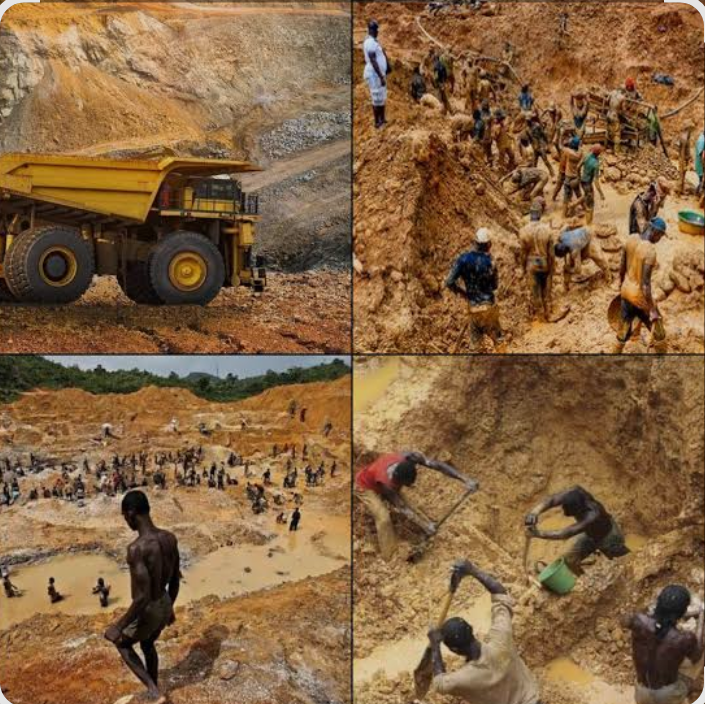
The Federal Government has recorded a major breakthrough in its solid minerals sector following the discovery of a world-class polymetallic mineral province in Kaduna State containing platinum group metals, gold, nickel, copper, lithium and rare earth elements.
The Minister of Solid Minerals Development, Dele Alake, announced the development on Wednesday at the opening ceremony of the African Natural Resources and Energy Investment Summit 2026 in Abuja, themed “One Africa, One Resource Vision.”
He made the announcement just as Steron Mining and Company Limited, unveiled an estimated 3.3 million metric tonnes of lithium reserves at its Abuja mining site during a facility tour for summit delegates.
The development underscores the rising pace of exploration activities and Nigeria’s push toward value-added processing and manufacturing rather than raw mineral exports.
Alake described the discovery as one of the most significant developments in Nigeria’s mining industry in recent years, adding that it had been verified by the Nigerian Geological Survey Agency and could strengthen the country’s position in the global competition for critical minerals.

He explained that the discovery was made by a private company working in collaboration with the agency.
Making the discovery public, Alake noted that the mineral province contains exceptionally high-grade deposits of strategic minerals that are increasingly in demand globally for clean energy technologies and advanced manufacturing.
“This is the first time I am announcing this publicly. Recent exploration breakthroughs verified by our Nigerian Geological Survey Agency, have unveiled a world-class polymetallic mineral province in Kaduna State, consisting of world-class platinum group metals, precious and critical mineral deposits.
“The province is notable for significant deposits of gold, nickel, copper, lithium and rare earth elements of exceptionally high grades, positioning Nigeria among the emerging destinations for strategic mineral resources and sustainable mining investment.
“This is a new discovery by a private company assisted by our agency, the Nigerian Geological Survey Agency,” the minister said.
The announcement also came as the minister outlined sweeping reforms being implemented by the federal government to reposition mining as a key driver of economic growth and industrialisation.
According to him, the President Bola Tinubu administration has identified the solid minerals sector as a strategic pillar of economic diversification, with policies designed to attract investment, promote local processing and increase government revenue.
He said Nigeria is gradually shifting away from exporting raw minerals toward domestic beneficiation and value addition.
“For too long, Nigeria’s mineral endowment did not translate into sufficient national value… vast mineral potential but limited beneficiation, rising global demand but inadequate geological confidence, legal authority but weak enforcement, abundant activity but too much informality.
“We have had to revoke over 3,000 dormant and defaulting mineral titles as part of a broader clean-up aimed at discouraging speculation, freeing idle assets and restoring seriousness to licence holding.
“We introduced a requirement that applicants for mining leases must submit detailed value-addition plans… Nigeria will no longer be satisfied with a pit-to-port model in which raw minerals leave the country without domestic transformation,” he said.
“We want mining investments that lead to processing plants, refineries, industrial clusters, local jobs, technology transfer and stronger linkages with the wider economy.
“There is an $800m lithium processing project investment… a $600m lithium processing factory in Nasarawa… a $200m lithium factory near Abuja ready for commissioning… and a $50m lithium factory in the FCT already expanding,” he said.
“There is also a $1bn iron ore-to-steel project in Kogi State. These are the types of midstream and downstream investments that begin to change the structure of an economy,” he stated.
Alake added that mining sector revenues have risen sharply since the reforms began.
He said revenue grew from about N6bn before the administration to over N38bn in 2024 and crossed N70bn by the end of 2025.
“Our revenue performance has improved significantly… from roughly N6bn to over N38bn and now beyond N70bn,” he said.
The minister also called for stronger African cooperation in resource development, arguing that the continent’s future depends on integration, value addition and industrialisation.