


By Sam Otuonye
First Secretary, Head of Development Cooperation at the German Embassy to Nigeria, Dr. Karin Jansen, has commended the Nigerian Electricity Management Services Agency (NEMSA), on sticking to the rules of interconnecting solar mini grids to distribution network, highlighting the importance of complying with the right technical standards, effective oversight mechanisms and clear guidance.
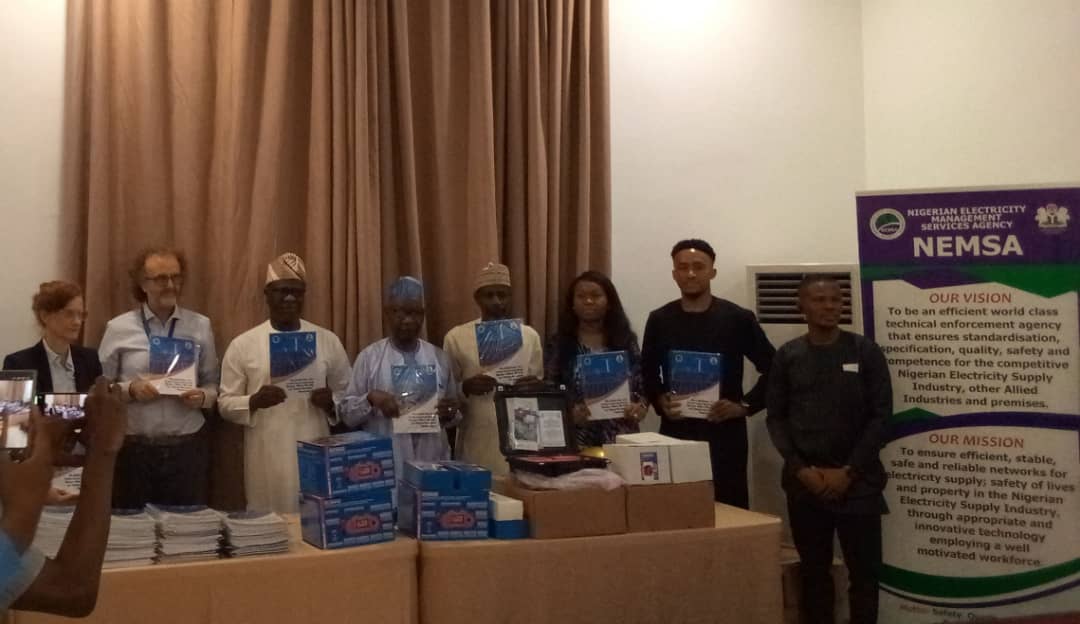
Dr Jansen made the remark at the official launch for Interconnecting Solar Mini Grids to Distribution Network and Hand over of Procured Solar Test Equipment to NEMSA on Tuesday, June 2, 2026, in Abuja.

“And that we can see really NEMSA as not only an advocate and a rule setter, but also an institution that can really make sure that the right standards are actually applied.
“We are testifying to the fact that in the case of interconnected mini-grids which has been the chief endeavor of the european and german cooperation over the years we have not made any discounts on regulation the interconnected mini-grids which have been pursued under under the nigeria energy power support program they are actually the epigons i mean the
examples that we are building on to establish now the standards that we are launching today. And those standards, they’ve been developed while compliance was assured.
“Over the past decade, Nigeria’s solar mini grid sector has become one of the fastest growing market in Africa, reflecting the strong commitment of the Government of Nigeria, its institutions, private sectors as well as the continued support from the development partners. As the market continues to grow and mature, it is essential that this growth is supported with the right technical standards, effective oversight mechanisms and clear guidance that promotes uniformity, safety, quality, and investor confidence,” she stated.
She noted that Nigeria has made a great inroad into the deployment of solar mini grids from the isolated to the interconnectivity to distribution network.
“As we all know, solar mini grids have made significant progress in Nigeria, from the deployment of early isolated solar mini grids to the increasing adoption of interconnected solar mini grids that are helping to extend reliable and sustainable electricity to rural and peri-urban communities in Nigeria.”
The EU representative said that with the launch of the guidelines, it is expected that the document would provide clear guidance for developers, electricity distribution companies, financiers, stakeholders, development partners and interested new entrants in the market and bring uniformity for such projects, while ensuring that interconnected solar mini grids are developed in a manner that is safe, efficient and aligned with international best practices, thereby supporting the long-term sustainability of the sector.
She said Germany, through the Federal Ministry for Economic Cooperation and Development (BMZ), is proud to support Nigeria’s efforts to expand energy access and strengthen the foundations for a thriving renewable energy market.
She further stated that through the long-standing Nigerian Energy Support Programme (NESP), we have worked closely with government institutions and sector stakeholders to promote policy reforms, capacity development and market-based solutions that contribute to Nigeria’s energy transition objectives.
In his remarks, the Managing Director/ CEO, NEMSA and Chief Electrical Inspector of the federation, Engineer Olusegun Adesayo, said that technical support of the Nigerian Energy Support Programme (NESP), co-founded by the EU and the Government of German, and implemented by GIZ in collaboration with the Federation of Power of Nigeria has marked another important milestone
in the journey towards achieving a safe, reliable, sustainable and inclusive electricity supply industry.
Engr. Adebayo noted that the importance of access to electricity even to the grassroot cannot be overemphasized in view of its socioeconomic and developmental imperatives.
“As we all know, access to electricity remains fundamental to economic growth, social development and national prosperity. In this regard, solar mini-grids have emerged as a critical solution for electrified, unserved and
underserved communities across the country.”
He noted the strategic need for a clear guidelines to support the project given its expanded network.
“However, as interconnected solar mini-grids continue to expand within NEMSA, there is an increasing need for clear technical and locational frameworks to ensure that these systems are integrated safely, efficiently and sustainably into
existing distribution networks. This necessity informs the development of these guidelines.
“The guidelines provide comprehensive procedures, technical requirements, interconnection models and operational standards for integrating solar mini-grids to distribution networks without
compromising grid stability, mini-grid distribution networks without compromising grid stability,
power quality, system reliability and public safety.
“They also seek to reduce uncertainties for investors and developers while strengthening collaboration among discourse, mini-grid developers, regulators and other stakeholders. Importantly, the guidelines align with the provision of the EA 2023, the mini-grid regulation 2026 and relevant national and international standards,
including IEC.”
He commended various development partners who contributed to the success of the document including the Nigerian Energy Support Programme, the European Union, the Government of German, GIZ and the Federal Minister of
Power for their invaluable technical and institutional support.
Also, speaking were Representative from the EU delegation to Nigeria and ECOWAS, Mr Massimo Dehuca, Representatives from Developer’s Association and AEDC, among others. In their remarks, they commended the initiative as imperative on a safe, sustainable and inclusive access to electricity.