

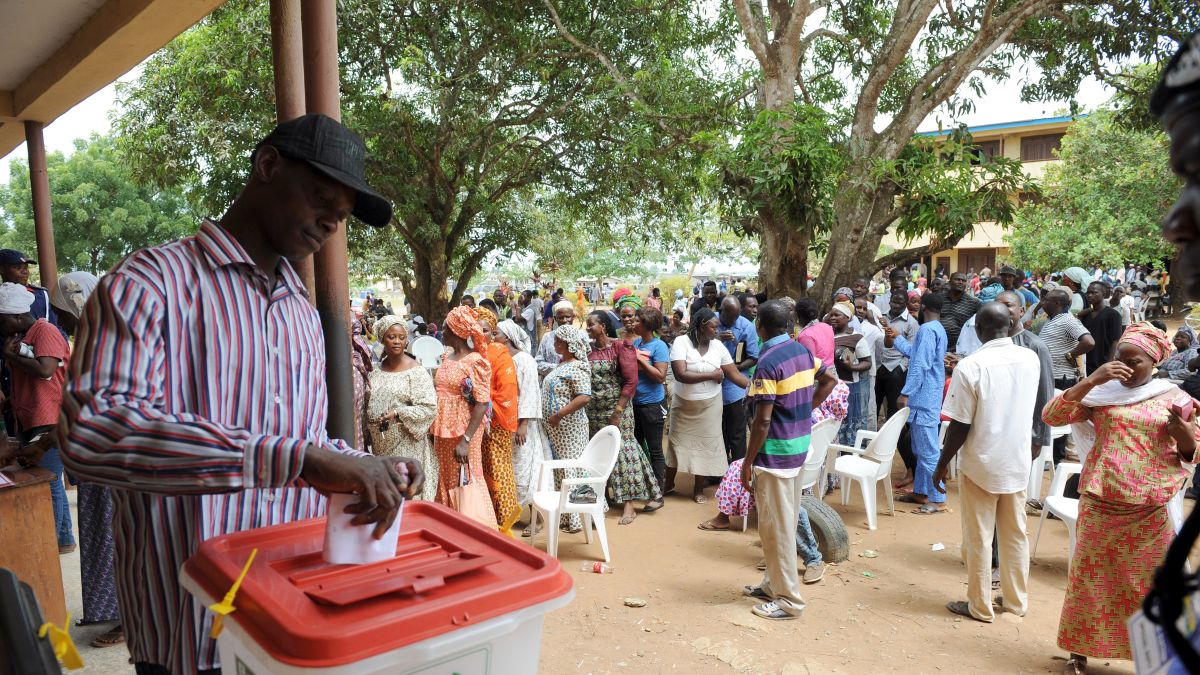
The Independent National Electoral Commission (INEC) has selected 17,656 polling units across the 36 states of the federation and the Federal Capital Territory (FCT) for its nationwide mock accreditation and result upload exercise scheduled for Saturday, November 28, as part of preparations for the 2027 general elections.
The exercise, which will hold between 8:30am and 2:30pm, is designed to test the functionality of the Bimodal Voter Accreditation System (BVAS), assess accreditation procedures and identify potential technical challenges ahead of the 2027 general elections.
INEC announced the exercise in a post on its official X handle, explaining that the exercise would be conducted in two polling units in each of the country’s 8,838 Registration Areas.
However, an analysis of the list released by the commission shows that a total of 17,656 polling units have been selected, 20 fewer than the 17,676 expected based on the announced selection formula of two polling units per Registration Area.

A breakdown of the selected polling units across the states shows that Kano has the highest number with 968, followed by Katsina with 718 and Oyo with 702.
Osun has 664 polling units, Akwa Ibom 658, Anambra 652 and Rivers 638, while Borno has 622 and Imo 610.
At the other end of the distribution, the Federal Capital Territory has the lowest number with 124 polling units, followed by Bayelsa with 210 and Gombe with 228.

A regional breakdown indicates that the North-West has the highest share with 4,002 polling units, representing 22.7 per cent of the national total.
The South-West follows with 3,088 polling units, representing 17.5 per cent, while the South-South accounts for 2,874, or 16.3 per cent.
The North-Central has 2,785 polling units, representing 15.8 per cent, followed by the South-East with 2,489 (14.1 per cent) and the North-East with 2,418 (13.7 per cent).
Further analysis shows that the three northern geopolitical zones account for 9,205 selected polling units, representing 52.1 per cent of the total, while the southern geopolitical zones have 8,451, or 47.9 per cent.
Within the North-West, Kano leads with 968 polling units, followed by Katsina with 718 and Jigawa with 574.
In the South-West, Oyo has the highest number with 702, followed by Osun with 664 and Lagos with 490.
Akwa Ibom leads the South-South with 658 polling units, followed by Rivers with 638 and Delta with 598.
In the South-East, Anambra has the highest number with 652, followed by Imo with 610 and Enugu with 520.
For the North-Central, Benue leads with 552 polling units, followed by Niger with 548 and Kogi with 478, while Borno has the highest number in the North-East with 622, followed by Adamawa with 452 and Bauchi with 424.
The commission said the exercise is intended to enable it to assess the performance of its electoral technology, evaluate accreditation procedures and identify operational gaps that may require attention before the 2027 general elections.
INEC has also published the list of selected polling units for public information, providing details of their respective states, local government areas, wards, polling unit names and identification codes.