

After an open confrontation resulting in a verbal war over the legitimacy or otherwise of the N70,000 transport allowance approved for public service workers by President Bola Ahmed Tinubu, Nigeria’s two leading labour unions, the Nigeria Labour Congress (NLC) and the Trade Union Congress of Nigeria (TUC), have put off their fire.
The development followed the intervention of former leaders of both workers unions.
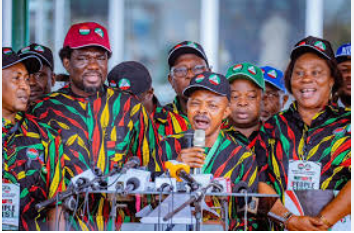
Announcing the reconciliation at a joint press conference on Wednesday 18 October, 2026 in Abuja, the warring unions agreed to forge a united front in their struggle to protect workers interests.

Their resolutions were also put in a joint statement signed by the NLC President, Comrade Joe Ajaero, and Comm. Hassan Sumonu, a foremost labour leader, stating that they have resolved their disagreements.
Comm. Sumonu led the for.er leaders’ team that intervened in the crisis.
The two labour groups recommitted to unity, solidarity and the protection of Nigerian workers’ rights and welfare.

While acknowledging the misunderstanding between the two labour unions, they said the intervention of their former leaders had successfully resolved the impasse.
According to the trade unions, “it is no longer news that a family misunderstanding arose between the two Labour Centres, which unfortunately played out in the public domain.
“However, in the true spirit of labour solidarity, maturity and collective responsibility, distinguished former presidents of NLC and TUC intervened.
“We are pleased to announce that their intervention has yielded the desired results, and the misunderstanding has been amicably resolved.”
According to them, the unity of Nigerian workers was more important than disagreements among their leaders, expressing their readiness to work together in the interest of workers, pensioners and other vulnerable groups.
The labour leaders also said the challenges confronting Nigerian workers required solidarity rather than division, noting that their common struggle must not be undermined by institutional differences or leadership disagreements.
Workers’ welfare, dignity and material well-being, they said, remained non-negotiable, pointing out that their renewed partnership would focus on confronting exploitation, defending decent work, demanding economic justice and resisting policies they consider detrimental to workers and pensioners.
They said, “We are determined to ensure that our differences do not provide an opportunity for anti-worker forces to weaken the labour movement or undermine the gains achieved through decades of collective struggle.” they said.
And in a further bid to sustain the reconciliation, the labour centres said they had agreed to introduce measures to promote mutual respect, strengthen working relations, establish effective mechanisms for resolving future disagreements and prevent a recurrence of such disputes.
They listed the six former labour leaders that intervened to include Comrades Sunmonu, Peace Obiajulu, Peter Esele, Ayuba Wabba, Bobboi Bala Kaigama and Quadri Olaleye, describing their decision as a demonstration of the enduring values and shared sacrifices upon which the labour movement was built.
Similarly, they called on their affiliates, state councils, industrial unions, workers and pensioners across the country to remain united and committed to the collective struggle.
They finally called on workers not to allow the disagreement to erode their confidence in the two organisations, saying both centres remained united in their pursuit of social and economic justice.