


By Gloria Akudoro
FGN Power Company Limited has called for an urgent shift toward bankable, private-sector-led investment models to resolve Nigeria’s electricity infrastructure deficit, warning that public funding alone cannot sustain the country’s ambition of building a $1 trillion economy.
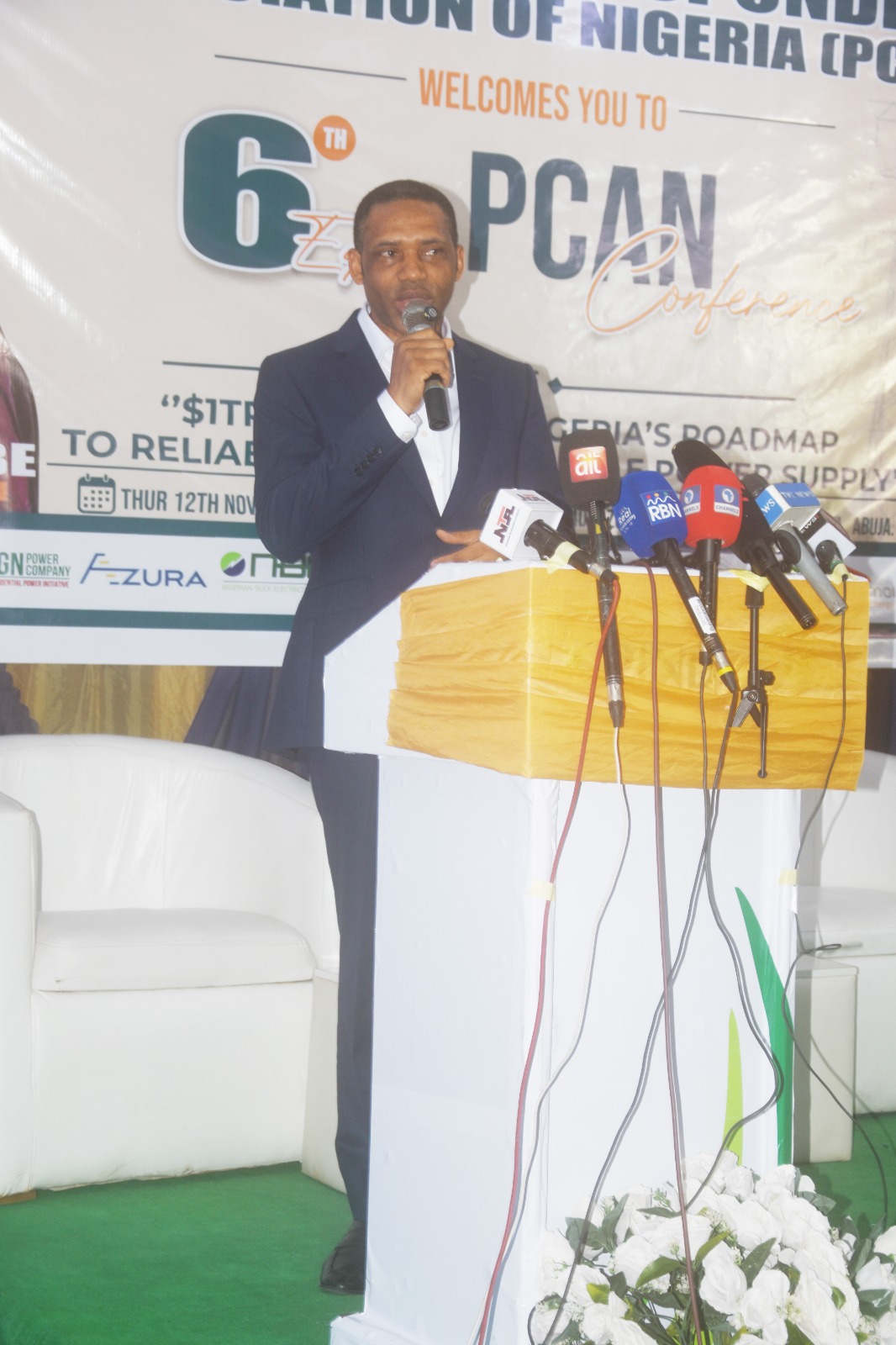
Delivering a keynote address at the sixth annual conference of the Power Correspondents Association of Nigeria (PCAN) in Abuja on Thursday, the Managing Director and Chief Executive Officer of FGN Power Company, Mr. Kenny Anuwe, said the Federal Government has spent over N10 trillion in the power sector since privatisation, yet continues to shoulder more than 95 percent of new infrastructure investments.

Anuwe noted that while government interventions kept the electricity industry afloat, the country must now unlock scalable financing frameworks – including blended finance and viability funding – as it works toward adding 5,540 megawatts (MW) of incremental grid capacity and boosting grid reliability by at least 60 percent by 2029.
“The government has invested over N10 trillion in the electricity sector since the advent of privatisation. But is it enough? How much money is enough? If the government didn’t invest that money, the industry would not be standing today,” Anuwe said.
“However, in spite of that significant amount of money, it is frustratingly limited in terms of what our ambitions are. There is a serious problem which has left the government alone in the space of providing more than 95 percent of new infrastructure investment in the sector. Surely that’s not right. That’s not why we privatized,” he added.

To bridge the funding gap and hit the 2029 target of 5,540MW, Anuwe disclosed that FGN Power Company is seeking a $1 billion recapitalisation, which the Africa Finance Corporation (AFC) has pledged to match, alongside an additional $18 billion expected from external financiers into the wider power sector.
He explained that under the Presidential Power Initiative (PPI), the Federal Government has so far utilized a sovereign guarantee model backed by 15 percent counterpart funding on a $2.3 billion programme – comprising $1.3 billion from European financiers and $1 billion from China – to execute critical grid upgrades.
According to him, the 5,540MW capacity expansion by 2029 is anchored on ongoing Phase One transmission substations and lines scheduled for completion in the first quarter of 2027, alongside pipeline projects including Siemens Batch Two – covering 12 substations, and special projects at Omotosho substations, which will kick off in the fourth quarter of 2026 to deliver nearly 3,400MW.
Anuwe also highlighted significant progress on the flagship 480MW transmission substation project in Abeokuta, noting that commissioning tests will commence in December 2026 and conclude in February 2027, alongside the deployment of 16 transmission lines spanning 606 kilometres backed by $237 million in administration funding to improve evacuation throughput by over 7,000MW.
He projected that achieving the 5,540MW target by 2029 would yield substantial economic dividends, including bringing at least 2,000 off-grid industries back onto the national grid and significantly expanding power supply to households and key commercial load centres.
“Our overall impact that we are targeting by the year 2029 is 5,540 megawatts, and that will improve reliability by at least 60 percent of what we are currently experiencing on the grid,” Anuwe stated.
Beyond physical infrastructure, the FGN Power boss stressed that Nigeria cannot achieve the 10,000MW to 30,000MW aggregated energy required for a $1 trillion economy without simplifying multi-layered regulatory, contracting, and institutional bottlenecks across generation, transmission, distribution, and gas supply.
“Can infrastructure alone solve the sector’s problems? In reality, no. What we need is an extraordinary institutional, commercial, and regulatory arrangement that allows all of these things to work well. Right now, they are too complex,” he said.
Urging private investors and sector stakeholders to take ownership of the delivery plan, Anuwe concluded: “Government cannot do everything, and we need to change our minds about that reality. Government can provide the enablers, provide infrastructure delivery, and market conditions under which public and private capital can perform effectively.”