

The Independent National Electoral Commission (INEC) has declared that it has no preferred presidential candidate or political party ahead of the 2027 general election, insisting that its allegiance is to the rule of law and the sovereign will of Nigerians.
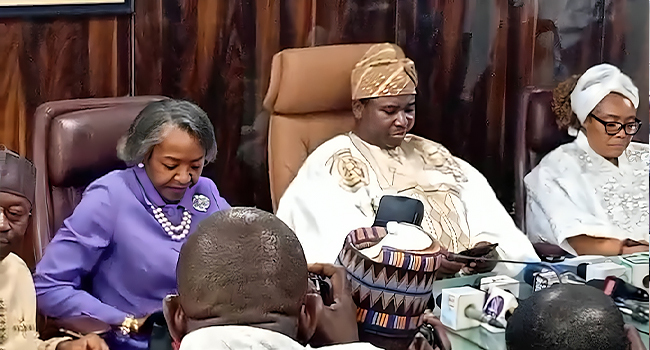
INEC Chairman, Prof. Joash Amupitan (SAN), stated this on Friday while receiving a delegation of the Economic Community of West African States (ECOWAS) Pre-Election Fact-Finding Mission at the commission’s national headquarters in Abuja.

He said the commission was committed to conducting a credible, transparent and peaceful election, adding that Nigeria’s electoral process had significant implications for democratic stability across West Africa.
“I assure you, and through you, the Authority of Heads of State and Government of ECOWAS, that the Independent National Electoral Commission under my watch has no candidate and no political party. Our sole allegiance is to the rule of law, the sovereign will of the Nigerian electorate, and the democratic progress of our nation,” Amupitan said.
The ECOWAS delegation was led by former Vice-President of Sierra Leone, Mr. Victor Bockarie Foh, and co-headed by former ECOWAS Executive Secretary and former Speaker of the Parliament of Sierra Leone, Dr. Abbas Chernor Bundu.

Amupitan described the visit as an important demonstration of regional commitment to constitutional governance, electoral integrity and accountability.
He said Nigeria’s uninterrupted democratic journey since 1999 had made the 2027 general election a significant milestone, particularly at a time when parts of West Africa were navigating political transitions and security challenges.
According to him, the country’s National Register of Voters has surpassed 103 million registered citizens, with INEC preparing to conduct elections across the 36 states and the Federal Capital Territory.
The commission will cover 774 local government areas, 8,809 registration areas and 176,846 polling units, he said.
Amupitan announced that the presidential and National Assembly elections were scheduled for Saturday, January 16, 2027, while the governorship and state Houses of Assembly elections would hold on Saturday, February 6, 2027.
The INEC chairman disclosed that the commission had completed nine of the 14 major statutory milestones contained in its revised timetable and schedule of activities for the 2027 elections.
He said the commission had also concluded three phases of the Continuous Voter Registration exercise and recently completed the physical display of the preliminary register of voters at registration areas nationwide.
According to him, the preliminary register had also been made available online through the commission’s dedicated portal to enable Nigerians scrutinise the records and submit claims and objections before the final register is certified.
He said the final register of voters was scheduled for certification on December 15, 2026.
To assess operational readiness, Amupitan explained that INEC had embarked on zonal readiness assessment tours across the country’s geopolitical zones.
He said assessments had been completed in the South-West, North-West, South-East and North-East, with the South-South assessment scheduled to take place in Port Harcourt, Rivers State.
The exercise, he added, would enable the commission to engage field personnel, inspect logistics and infrastructure, and consult traditional and community leaders.
On technology, Amupitan said INEC had upgraded its hardware and software systems to strengthen electoral transparency and public confidence.
He explained that the Bimodal Voter Accreditation System (BVAS) would be deployed for biometric voter accreditation using fingerprints and facial recognition.
He also identified the commission’s electronic result management systems, including the newly introduced eEC8A electronic verification platform, as part of measures to improve the verification and transparent transmission of polling-unit results through the INEC Result Viewing Portal (IReV).
Amupitan said the commission had also introduced staff welfare reforms, including approval for the Consolidated Election Management Body Salary Structure and a 150 per cent increase in state operational overheads.
He said the reforms were intended to improve staff welfare and operational effectiveness, while warning that the commission maintained zero tolerance for negligence, extortion and partisan conduct.
The INEC chairman also highlighted security arrangements being developed through the Inter-Agency Consultative Committee on Election Security (ICCES), in collaboration with the Nigeria Police Force, Department of State Services, Nigeria Security and Civil Defence Corps and the Armed Forces.
He said the commission had operationalised an intelligence-driven security framework known as the “ICCES Tentacle” to identify and address risks around polling units, protect election personnel, including members of the National Youth Service Corps, and ensure voters could exercise their rights without intimidation.
He added that the arrangements were also intended to improve access for persons with disabilities.
Amupitan called for continued collaboration with ECOWAS, particularly in election observation, technical exchanges, voter education and combating electoral disinformation.
He said long-term and short-term election observation missions would provide independent assessments capable of strengthening international confidence in Nigeria’s electoral process.
He also urged ECOWAS to support efforts to counter sophisticated electoral disinformation, improve logistics in difficult terrain and promote inclusive voter education.
The chairman stressed that credible elections required collective responsibility from political parties, civil society organisations, the media and security agencies.
While INEC would serve as an impartial electoral umpire, he said political parties must uphold internal democracy and conduct peaceful campaigns, the media must combat fake news, and security agencies must provide neutral protection.
He assured the delegation that the commission was prepared to provide further technical briefings on its electoral preparations and welcomed the mission’s observations and recommendations.
The ECOWAS Pre-Election Fact-Finding Mission is engaging political parties, civil society organisations, security agencies and other stakeholders to assess preparations for the 2027 general election and the political environment ahead of the polls.
Other members of the delegation included Ambassador Francess Piagie Alghali, ECOWAS Commissioner for Political Affairs, Peace and Security, alongside technical experts and other representatives of the regional body.
Amupitan thanked ECOWAS for its continued partnership and support for democratic governance, expressing confidence that the mission’s findings would provide useful feedback as INEC fine-tunes its operational plans for the elections.