

By Rex Buchi Akwolu Esq
There are places that are more than brick and mortar. They are living testaments to dreams, sacrifice, and the quiet determination of a people who refused to accept second-class status in the story of their own nation. Zik’s Flat at the University of Nigeria, Nsukka is one such place.

In the early 1980s, Dr. Nnamdi Azikiwe, Nigeria’s first President, the founding father of UNN, and the eternal Owelle of Onitsha did not merely donate land or write a cheque. He built with his own resources and vision, he raised a sprawling student housing estate of roughly twenty two storey blocks and twelve bungalows. It offered more than 700 rooms and over 3,000 bed spaces, complete with cafeterias, shops, parking areas, and open play spaces. Before his death, on the occasion of his 85th birthday in 1989, the Great Zik formally handed these flats over to the university he founded, at a token cost. It was not a transaction. It was a father’s final gift to his children; an act of profound social investment in the young minds who would one day “restore the dignity of man.”
For decades, Zik’s Flat stood as the most sought-after hostel on campus, especially for first-year students. It was close to the Great Zik’s Onuiyi Haven, where the Azikiwe family still resides. Living there felt like sharing a perimeter fence with history itself. Students walked those corridors with a sense of belonging that went beyond accommodation. They lived inside the dream of the man who had fought for an indigenous university when others still looked outward for validation.
Then came the long night of neglect.

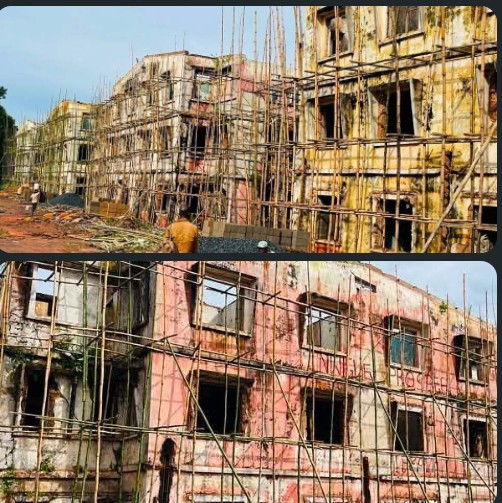
Over more than a decade of abandonment, the proud structures crumbled. Windows became empty sockets. Roofs surrendered to the elements. Vegetation and reptiles claimed the rooms that once echoed with laughter, debates, and late-night study sessions. What had been a beacon of hope turned into a public eyesore and a quiet national shame. Emeritus Professor Uche Azikiwe, Zik’s widow, repeatedly voiced her pain, offering even to take the property back and rebuild it under a Build-Operate-Transfer model if the university could not. The decline of Zik’s Flat was not just infrastructural failure; it was a wound to institutional memory.
Today, the scaffolding rises again. Bamboo poles brace the weathered walls. Fresh blocks are stacked. Workers move across the red earth. Steel rods lie ready. The photographs of this moment capture more than construction,they capture resurrection.
This reconstruction is not merely another project on a university work plan. It is the living embodiment of the clarion call issued by the 16th Vice-Chancellor of the University of Nigeria Nsukka, Professor Uchenna Simon Ortuanya, when he assumed office in August 2025: “Arise, let us rebuild.”
Like the biblical Nehemiah who surveyed the broken walls of Jerusalem and summoned his people to action, Professor Ortuanya looked upon an institution weighed down by years of accumulated decay and chose not to manage decline, but to reverse it. His declaration was never meant as a slogan. It was a summons to staff, students, alumni, and every stakeholder who still believes that the University of Nigeria must once again roar with the confidence of its founding vision.
The rebuilding of Zik’s Flat is the most poetic expression of that summons. Here is a structure that carries the personal signature of the university’s founder. Restoring it is not only about solving the chronic student accommodation crisis, though it will do that powerfully. It is about honouring the covenant between past and present. It is about telling every Lion and Lioness,past, present, and future, that their heritage is not disposable. It is about proving that leadership can still choose courage over convenience, memory over amnesia, and action over endless lamentation.
When these walls stand firm again, when lights shine once more through those windows, and when young Nigerians once again call Zik’s Flat home, something deeper will have been restored: the belief that institutions can heal, that neglect is not destiny, and that a generation can still answer the call to rebuild what was left broken.
Professor Ortuanya’s vision is already visible in rehabilitated roads, revived hostels, and renewed institutional energy across the campuses. But Zik’s Flat holds a special place in this renaissance. It is the emotional heart of the project. To rebuild it is to declare, in the most tangible way possible, that the University of Nigeria will no longer allow the gifts of its founders to decay into monuments of failure.
Arise, indeed.
Let the hammers ring. Let the scaffolds rise. Let every block laid on this sacred ground be a prayer and a promise. The man who founded this university once gave us these flats as a gift of love. The least we can do under the leadership that has summoned us to rebuild, is to receive that gift with gratitude, restore it with excellence, and hand it forward with pride.
Zik’s Flat is rising again. And with it, so is the soul of the University of Nigeria.
Arise, Lions and Lionesses. Let us continue to rebuild.
*Rex Buchi Akwolu Esq, published this piece on Enugu State Political Platform, 7 October, 2026