

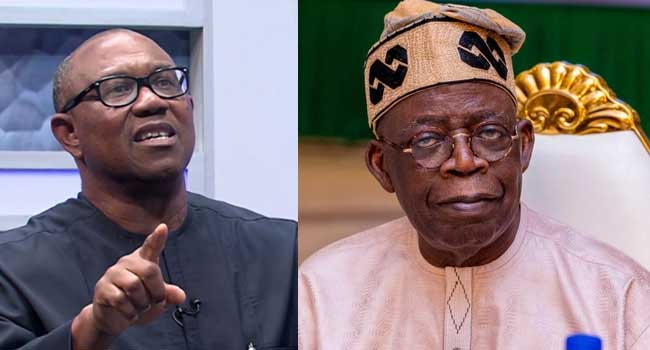
The presidential hopeful of the National Democratic Congress (NDC), Mr. Peter Obi, has raised concern over Nigeria’s rising debt burden, warning that debt servicing is increasingly overwhelming investments in critical sectors such as health, education, and poverty alleviation.
Obi made the remarks while reacting to comments attributed to President Bola Ahmed Tinubu during a recent foreign tour, where the President reportedly stated that Nigeria would spend about $11.6 billion on debt servicing. He said the figure reflects a troubling fiscal reality that demands urgent national attention.

According to him, borrowing is not inherently bad if it is channelled into productive investments capable of generating long-term economic returns. He cited several countries, including Japan, the United Kingdom, the United States, the United Arab Emirates, Singapore, and Indonesia, as examples of economies that manage high debt levels by investing in infrastructure, education, healthcare, and innovation.
He argued that Nigeria’s borrowing history differs significantly, claiming that a large portion of past loans has been directed toward consumption rather than productive development outcomes.
Obi further noted that Nigeria’s debt stock has continued to rise under the current administration. He listed recent external borrowing commitments, including about $6 billion in total external loans (comprising $5 billion from First Abu Dhabi Bank in the UAE and $1 billion via UK Export Finance through Citibank London), alongside a proposed $1.25 billion World Bank facility and an additional $516 million arranged through Deutsche Bank, bringing recent external borrowing commitments to approximately $7.8 billion. He also pointed to continued domestic borrowing through regular bond issuances.
He also highlighted budgetary figures showing that debt servicing, estimated at about ₦17–₦18 trillion depending on exchange rates, is nearly three times the combined allocations to health (₦2.46 trillion), education (₦2.56 trillion), and poverty alleviation (₦865 billion).
He described the imbalance as a major fiscal concern, warning that debt obligations are increasingly crowding out investments in human capital development. He also expressed concern that even approved funds for key sectors may not be fully released or effectively utilised.
Obi stressed that the key issue is not borrowing itself, but whether borrowed funds are converted into productivity, inclusive growth, and improved living standards.
He concluded that without such outcomes, debt servicing risks becoming a long-term structural burden on the economy.