

By Sani J. Suleiman
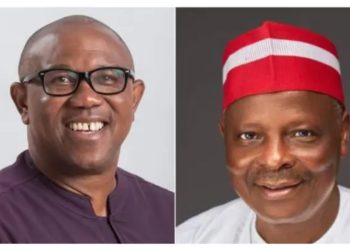
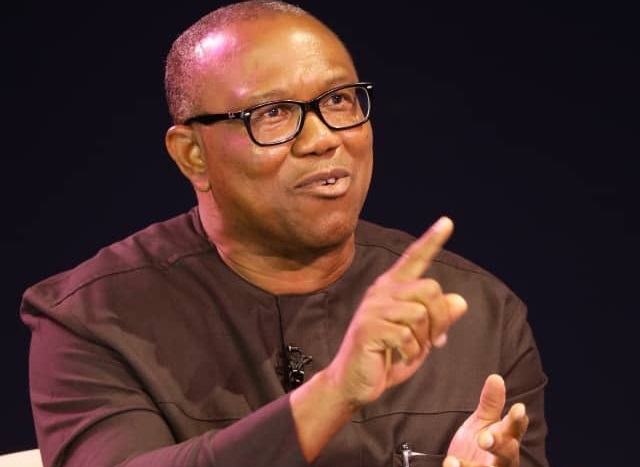
Peter Obi’s entry into Nigeria’s political landscape is a breath of fresh air in a system that often demonises those with differing views. His recent publicly stated advocacy for the release of Nasir el-Rufai has ignited significant discussions across Nigerian politics, especially considering their intense rivalry before and during the 2023 elections.
In the traditional Nigerian political playbook, Obi could have easily reminisced about the pivotal role el-Rufai played in thwarting his aspirations despite Obi being the people’s choice, el Rufai went for party loyalty and supported Bola Tinubu, who has now become his traducer.

However, what we are witnessing is not merely nostalgia; it is a strategic shift reflecting Obi’s commitment to a “politics of principles.” This shift serves as a foundation for a new political coalition—the African Democratic Congress (ADC)—as they gear up for the 2027 polls.
On March 9, 2026, Obi released a powerful statement on X, vehemently condemning the continued detention of el-Rufai and former Attorney General Abubakar Malami.
His argument rests on three essential pillars: fairness, the illegitimacy of the government’s “Fishing Expeditions,” and the undue “repeated transfers” of El-Rufai between the EFCC, ICPC, and DSS. Obi called out this approach as a “desperate search for any charge that might stick,” challenging the integrity of the investigations.
While he supports the fight against corruption, he insists that it must begin with those currently in power, emphasising that selective enforcement undermines the broader fight against corruption. He framed El-Rufai’s detention as “political persecution disguised as criminal prosecution.”

By defending a man who once dismissed him as a “tribal candidate” and a “Nollywood actor,” Obi is establishing himself as a leader who prioritises constitutional processes over personal grievances, elevating the rule of law above political grudges.
As a Northerner who once admired el-Rufai until the latter joined with Tinubu in 2022, I find Obi’s principled stance on el-Rufai’s detention to be a monumental moment for our politics and for the ADC Coalition.
Both Obi and el-Rufai have recently united under the ADC banner, and Obi’s defence of el-Rufai is a savvy move to fortify this coalition.
It sends a clear signal to northern power brokers that he is a fair partner, capable of putting aside past disagreements. I stand firmly with Obi’s supporters (Obidients) who interpret this act of magnanimity as evidence of his “superior temperament.” In a civilised society, detractors are entitled to fair treatment and the rule of law.
Yet, some critics may dismiss this “spirit of fairness” as merely a “marriage of convenience” with a former adversary. They are mistaken. It is high time for the North to cast aside its prejudices against Igbos and give Obi a chance.
He has a proven track record that can instil confidence, especially given his pragmatic vision that has the potential to transform the North. I am happy that a formidable Northern mobilizer like Rabiu Kwankwaso is trying to identify with this Obi project. Imagine how electrifying it would be to have a political movement like the Obidient and Kwankwansiyya groups on one platform.
The time has come for the North to confront the escalating poverty in our region—a situation that is primed to erupt into crisis. We must acknowledge that no one will escape the fallout when that happens. Let’s act decisively for the collective good.
*Suleiman wrote from Minna, Niger State.