

*Assures 2023 technical glitches will not reoccur in 2027 general elections
The Independent National Electoral Commission (INEC) has confirmed its earlier election schedule fixing the 2027 Presidential and National Assembly elections to hold on the 20th of February 2027, while governorship and state house of assembly elections will hold on the 6th of March, 2027.

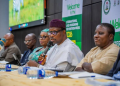
The INEC Chairman Prof. Joash Amupitan (SAN) made the confirmation on Friday in Abuja during the unveiling of Timetable and Schedule of activities for the 2027 general election.
The INEC boss said that by virtue of the Constitution of the Federal Republic of Nigeria, 1999 (as amended), tenure of the President, Vice-President, Governors and Deputy-Governors of States of the Federation (except Anambra, Bayelsa, Edo, Ekiti, Imo, Kogi, Ondo, and Osun States) will expire on the 28th day of May, 2027, while membership of the National and State Assemblies will stand dissolved on the 8th day of June, 2027.
Recall that INEC under the leadership of its immediate-past chairman, Prof. Mahmood Yakubu, already regularised and set dates for the conduct of general elections in the next 36 years.

A document titled “Professor Mahmood Yakubu, Chairman, Independent National Electoral Commission 2015 – 2025,” which was packaged by the Commission in honour of the erstwhile chairman, details several landmark innovations and achievements of the commission during the Prof. Yakubu’s tenure.
According to the document, the commission has through methodical planning, already set down the dates for the conduct of all general elections from 2027 to 2063, ten next general elections, spanning a period of 36 years, according to a story published in NewddeskAfrica, last year’s September 10, 2025.
In the document, the 2027 Presidential and National Assembly election will hold on 20th February, 2027, while the Governorship and State House of Assembly election has been slated for 6th March, 2027.
Similarly, the general election coming up in 2031, has been scheduled for 15th February, 2031 for the Presidential and National Assembly election, while the Governorship and State House of Assembly election is slated for 1st March, 2031.
“Pursuant to Sections 76(2), 116 (2), 132 (2) and 178 (2) of the Constitution of the Federal Republic of Nigeria, 1999 (as amended), elections to the said offices shall hold not earlier than One Hundred and Fifty (150) days and not later than Thirty (30) days before the expiration of the term of office of` the last holder of that office.
“In exercise of the powers conferred on the Commission by the Constitution of the Federal Republic of Nigeria, 1999 (as amended) and the Electoral Act, 2022 and of all other powers enabling it in that behalf, the Commission hereby sets in motion the electoral process for the 2027 General Elections and fixes the date for the 2027 General Elections as follows: Presidential & National Assembly- 20th February 2027. Governorship & State Houses of Assembly- 6th March 2027” the document noted.
Prof. Amupitan, while speaking on Friday, although did not refer to the document prepared by his predecessor, stated that detailed Timetable and Schedule of Activities have been uploaded on the Commission’s official website and circulated to all registered political parties and relevant stakeholders.
He added that all the 36 Resident Electoral Commissioners and that of the FCT have been directed to publish this Notice in each constituency in respect of which an election is to be held.
He said that these dates reflect the commissions commitment to ensuring that the electoral processes are transparent, credible, and adhere to the provisions of our laws.
*Technical glitches will not repeat
The INEC boss further reassured Nigerians that the technical glitches experienced in the 2023 general election will not repeat itself.
He said, “INEC is committed to ensuring that we improve. I think, everybody was horrifying during the presidential election when there were many cases. And this has completely eroded the confidence of Nigerians. So on our part, we have now committed to even having a mock presidential election.
“So we are doing everything possible to ensure that we test whatever we have. And I did not say that technology will not be used.
“This commission has come of age. We are going to use technology. So, BIVAS is being improved upon. BIVAS is being tested.
“Even last week, I went around FCT to ensure that we tested it. The BIVAS have been configured for FCT elevation and we tested everything to be sure that they are in order. So, the debate is going on.
“No matter how it ends, we already have our own system and an internal machinery to ensure that the results are transmitted.
“We are going to do everything possible not to disappoint Nigerians. We are going to be working with relevant agencies, law enforcement agencies. We are going to be working with other professional bodies, IT bodies, to ensure that the problems we had in the past, we do not encounter them”.
The Senior Advocate also defended the N850,073,000,000 2027 budget presented to the National Assembly, insisting that it was conservative.
He explained that the commission will increase the allowances of its ad-hoc staff including National Youth Service Corps (NYSC) members and also provide for security personnel.
“Our election budget is not 1 trillion. Our election budget is 850 and 73 billion. Compared to what we had during the 2023 election.
“Now, while we were at the National Assembly yesterday, my attention was drawn to the resolution of the House of Representatives, that we should increase the amount that we pay to our staff.
“And I said to them, unlike what happened in 2023, we have doubled the amount that we are supposed to be paying Corps members and other ad hoc staff.
“And the bill they were bringing yesterday was 32 billion Naira, just for Corpers. In every polling unit, you have four polling officers.
“You have the presiding officers, you have APO1, APO2, APO3… So there are four of them. So by implication, by the time you are increasing the amount that you are giving to NYSC for Corpers, you are also going to have the same for APO1, APO2, APO3. Now multiply 32 billion, that is just ad hoc staff costs.
“Then the cost of training. In fact, substantial part of the money goes for training. Then you are now talking also of inflation and forex.
“When you compare it to the 2023 election, we have to be modest in ensuring that the cost of the election is kept within bounds. Because everything has a cost” he stressed.