

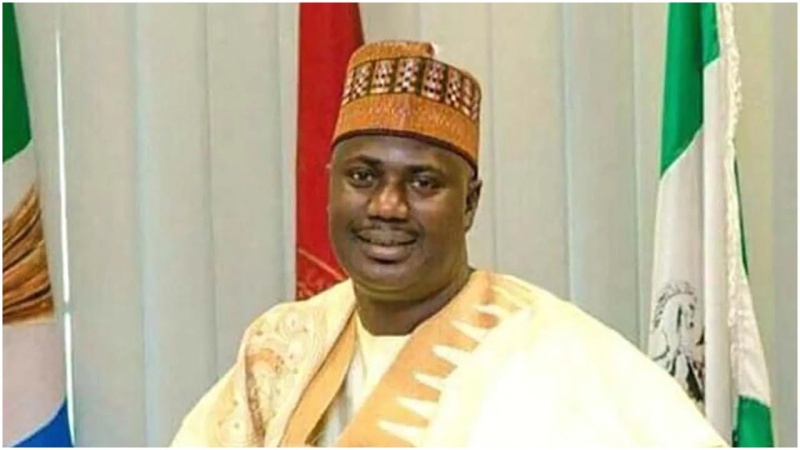
Members of the joint Senate and House of Representatives Committees on Agricultural Production on Tuesday quizzed the Minister of State for Agriculture and Food Security, Aliyu Sabi Abdullahi, over the whereabouts of the 2,000 tractors launched by the Federal Government under the Renewed Hope Agricultural Mechanisation Programme.
The session followed the minister’s appearance to defend the ministry’s 2026 budget.
Daily Trust reports that Bola Ahmed Tinubu had on June 23, 2025 commissioned 2,000 tractors, alongside other accompanying implements, for nationwide deployment under the Renewed Hope Agricultural Mechanisation Programme.

The commissioning ceremony marked the programme’s formal launch at the National Agricultural Seeds Council, Sheda, along the Abuja–Lokoja Expressway.
President Tinubu reaffirmed his administration’s commitment to transforming Nigeria’s agriculture sector by modernising farming practices and ensuring national food security.
However, almost eight months after the high-profile launch, the tractors are yet to be deployed across the country.

During the budget session, a member of the House of Representatives from Rivers State, Awaji Inombek, raised concerns over the non-distribution of the tractors months after their official launch by the president.
He asked the minister to clarify the whereabouts of the tractors, which he said had not been distributed to farmers.
Responding, Abdullahi said the delay was deliberate and aimed at preventing the failures that undermined previous tractor distribution programmes.
According to him, the tractors were procured under the Renewed Hope Agricultural Mechanisation Programme, which has three components, one of which is already being implemented through the Belarus Mechanisation Programme.
He disclosed that under the arrangement, the Federal Government procured 2,000 tractors of different capacities, including 85-horsepower and 75-horsepower tractors, combined harvesters, over 9,000 agricultural implements, and 12 mobile workshops.
“The question of what is happening to the tractors is a very pertinent one,” the minister said. “We are working very hard to put measures in place that will prevent a repeat of what happened in the past.”
Abdullahi recalled that in previous interventions, tractors were often allocated to non-farmers, forcing genuine farmers to pay exorbitant fees to access them, while many of the machines eventually became abandoned or dysfunctional.
He said President Tinubu had directed that the current programme must ensure tractor services are brought as close to Nigerian farmers as possible at minimal cost.
To achieve this, he explained that the Bank of Agriculture has been mandated to manage the process and has already advertised the programme, targeting three categories of beneficiaries: young Nigerians, women in agriculture, and general agricultural practitioners.
“Thousands of people have applied, and they are currently undergoing due process for selection,” Abdullahi said.
He noted that the plan is to establish Agricultural Mechanisation Service Centres across the six geopolitical zones. Successful bidders will be linked to financing and will operate the centres, making tractor services available to farmers on a pay-per-use basis.
“With this model, a farmer with one hectare, half a hectare or two hectares can access tractor services, pay for the service and continue with farming activities, while the operator is responsible for maintenance,” he explained.
The minister stressed that the government had moved away from the old practice of allocating tractors directly to individuals, which he said yielded little result and contributed to Nigeria’s stock of over 7,000 dysfunctional tractors.
He added that, unlike past interventions, spare parts for the newly procured tractors have been supplied, while young Nigerians are being trained to handle repairs and maintenance.
Abdullahi assured lawmakers that although the process was taking time, the rollout would begin gradually as the rainy season approaches.
“Our target is to ensure that as the rainy season approaches, we begin a gradual rollout. That is what is happening with the tractors,” he said.
He said the ministry’s strategy is anchored on the food security emergency declared by President Tinubu, with emphasis on scaling agricultural output across value chains and strengthening farmers’ resilience.
He thanked lawmakers for their continued support to the ministry through successive budget cycles and reaffirmed the ministry’s commitment to the prudent utilisation of public resources.
According to him, despite prevailing financial constraints, Nigerian farmers have shown strong commitment to production, with government surveys indicating marginal increases in output.
He noted, however, that sustaining those gains requires addressing structural challenges confronting producers nationwide.
On budget implementation, Abdullahi explained that personnel expenditure under the 2025 appropriation was largely implemented, but capital project execution has been significantly constrained by delayed releases. For the main ministry, about 30 per cent of the capital allocation—representing roughly N18 billion—has yet to be released.
The Chairman of the House of Representatives Committee on Agricultural Production and Services, Bello A. Ka’oje, warned that reduced funding for the agricultural sector could undermine Nigeria’s food security ambitions and weaken economic recovery efforts if urgent corrective measures are not taken.
He described the exercise as a constitutional responsibility anchored on transparency, accountability and prudent oversight, stressing that lawmakers are determined to ensure public spending translates into measurable improvements in Nigerians’ lives.
Ka’oje said the committee’s review would be guided by the Renewed Hope Agenda of President Tinubu, with a focus on how public resources are translated into actionable strategies capable of delivering food self-sufficiency, mechanisation, youth empowerment and import substitution.
Chairman of the Senate Committee on Agriculture, Production and Rural Development, Saliu Mustapha, urged the Federal Government to prioritise adequate funding and timely release of resources to the agricultural sector to safeguard food security and support economic growth.
Mustapha said low implementation of capital projects in the 2025 budget had constrained productivity in the sector.
He noted that while total national expenditure is projected to rise to N58.47 trillion in 2026, allocation to the agriculture ministry declined from N2.22 trillion in 2025 to N1.45 trillion, warning that insufficient funding could worsen food insecurity and undermine economic recovery.
The committee chairman said agriculture remains Nigeria’s most viable pathway to poverty reduction and employment generation, stressing that strengthened implementation and predictable funding are essential to stabilise the nation’s food system. (Daily Trust)