

There are strong indications that the escalating political tensions in Rivers State over the impeachment threat on Governor Siminalayi Fubara and his deputy, Prof Ngozi Odu, over alleged gross misconduct, would soon be doused as the two warring camps appear poised to sheath their sword.
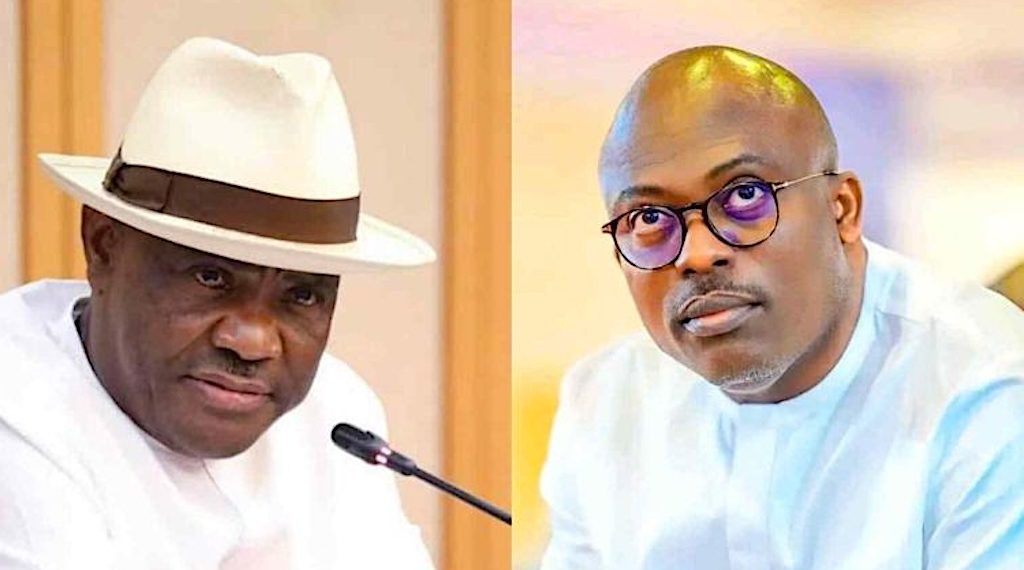
This happened as Sunday Vanguard gathered, at the weekend, that the two major principal actors in the crisis, Minister of Federal Capital Territory, FCT, Nyesom Wike, and his estranged godson, Fubara, have shown a considerable sign of backing down after meeting with the peace and reconciliation committee set up by the Pan Niger Delta Elders Forum, PANDEF, to proffer solution to the crisis.
A credible source revealed that the 7-man peace committee, led by Chief Kanu Agabi (SAN), otherwise known as the Agabi Peace Committee, first met with Wike in Abuja last Thursday before having another round of three-hour interface with Fubara on Friday in Port Harcourt.

The committee, which had earlier met with the Chairman of Rivers State Elders Council, Chief Ferdinand Anabraba, a very close ally of the FCT Minister, also met with elders and leaders from both Wike and Fubara camps yesterday in Port-Harcourt.
“So far, those meetings were very fruitful,” the source said, adding: “Don’t forget that before now people had made public statements. A lot of things were said, but the outcome of those meetings is very encouraging. I can say that there is hope. A real renewed hope. Rivers people respect this committee and I will appeal to Nigerians to allow these illustrious sons and daughters of the Niger Delta region to do their work.”
The Agabi Committee was inaugurated in Abuja, last week, to reconcile the two warring parties and turn in its report within two weeks for further action. It is expected that the Port Harcourt meeting with the elders would proffer a workable solution to bring the political impasse in the state to an end.

The source said that If Wike and Fubara had refused to meet with the committee, for instance, “then there would have been a genuine reason to be afraid that the effort would not yield a positive result”. “He emphasised: “But right now, things are going on very well and there is every reason to hope for the best outcome.”
Meanwhile, there may be a fresh reason why the lawmakers, including the four who earlier called for a political solution to the crisis, suddenly rescinded their earlier call for impeachment.
Sunday Vanguard investigations revealed that the lawmakers want to extract a genuine commitment from the governor that they would be given return tickets in the 2027 general elections.
“There is nothing like a gross misconduct against the governor. What these people (lawmakers) want is the assurance that they will return to the Assembly next year. With this attitude of theirs to the governor, they are not sure of coming back. That is the assurance they want. That is the agreement they are talking about,” a key player who pleaded anonymity said.
“If you can recall, this whole problem started when Governor Fubara defected to the APC last December. They knew that the governor would have his automatic ticket in APC and if they don’t get that assurance, then they would be dead politically.”
The player went on: “Wike also wants the same commitment from President Bola Tinubu. He wants to return as a minister. If Fubara wins second term and Wike loses his appointment, he would be dead politically. The minister said so himself. That is why he is using the Assembly to press home his demand from the President.”
He revealed that while the impeachment may not see the light of day beyond the level it has reached, “the minister no more has a direct access to the President. He can only use the Assembly to bargain for his political future.”
*Rivers APC
In a related development, the state chapter of All Progressives Party, APC, has urged the state Chief Judge, Justice Simeon Amadi, to obey the ruling of the state High Court, which issued an order restraining him from receiving any correspondence from the Speaker of the state Assembly, the Clerk of the House or any other person on the bid to impeach Fubara and Odu.
The Assembly, on Friday, said it had transmitted a letter to the Chief Judge to set up a 7-man panel to investigate allegations the gross misconduct leveled against Fubara and Odu.
But the Chief Emeka Beke-led APC, yesterday, said, having analyzed the issues leading to the latest step taken by members of the Rivers State House of Assembly to proceed with the Impeachment process, “we note that Honourable members who trumpeted loyalty to our party and Mr President can give themselves to the unfolding choreographed legislative coup d’etat against the collective interest, growth and development of our party in the state.”
The statement, signed by Darlington Nwauju, spokesman for the party, called on the “Honourable Chief Judge of Rivers State to respect yesterday’s interim injunction in Suit No OYHC/7/CS/2026 that restrained him from receiving or acting on the resolutions of the Rivers State House of Assembly”.
It further said: “We warn again that this is a needless legislative overreach, having observed the recalcitrance on the part of members of the House of Assembly, including APC members.
“Thus, no matter how beautifully crafted the allegations against the Governor and his Deputy are, they are still very subjective in the court of public opinion. This unfortunate path chosen by the legislative arm therefore serves as dangerous footnote to the health and survival of the APC in Rivers State.”
The party, however, called on the national leadership of APC to immediately activate internal mechanisms available to the National Working Committee, NWC, under Article 21(b)(iii) of the 2022 Constitution (as amended) to save the party from an embarrassing situation.
The Wike-Fubara crisis in Rivers State began as a bitter power struggle between the governor and his former political mentor. Although Wike helped Fubara win the governorship in 2023, their relationship quickly soured amid disputes over control of state politics, legislative cooperation and implementation of agreements they had reached.
The conflict deepened into a full-blown political standoff, with lawmakers loyal to Wike frequently clashing with the governor’s camp, leading to paralysis in governance and repeated legal and political battles between the executive and the legislature.