


By Ifeatu Agbu
“Our rewind to rebirth initiative provides the foundation for our current trajectory of transiting from transaction to transformation in the process of developing the Niger Delta region.”

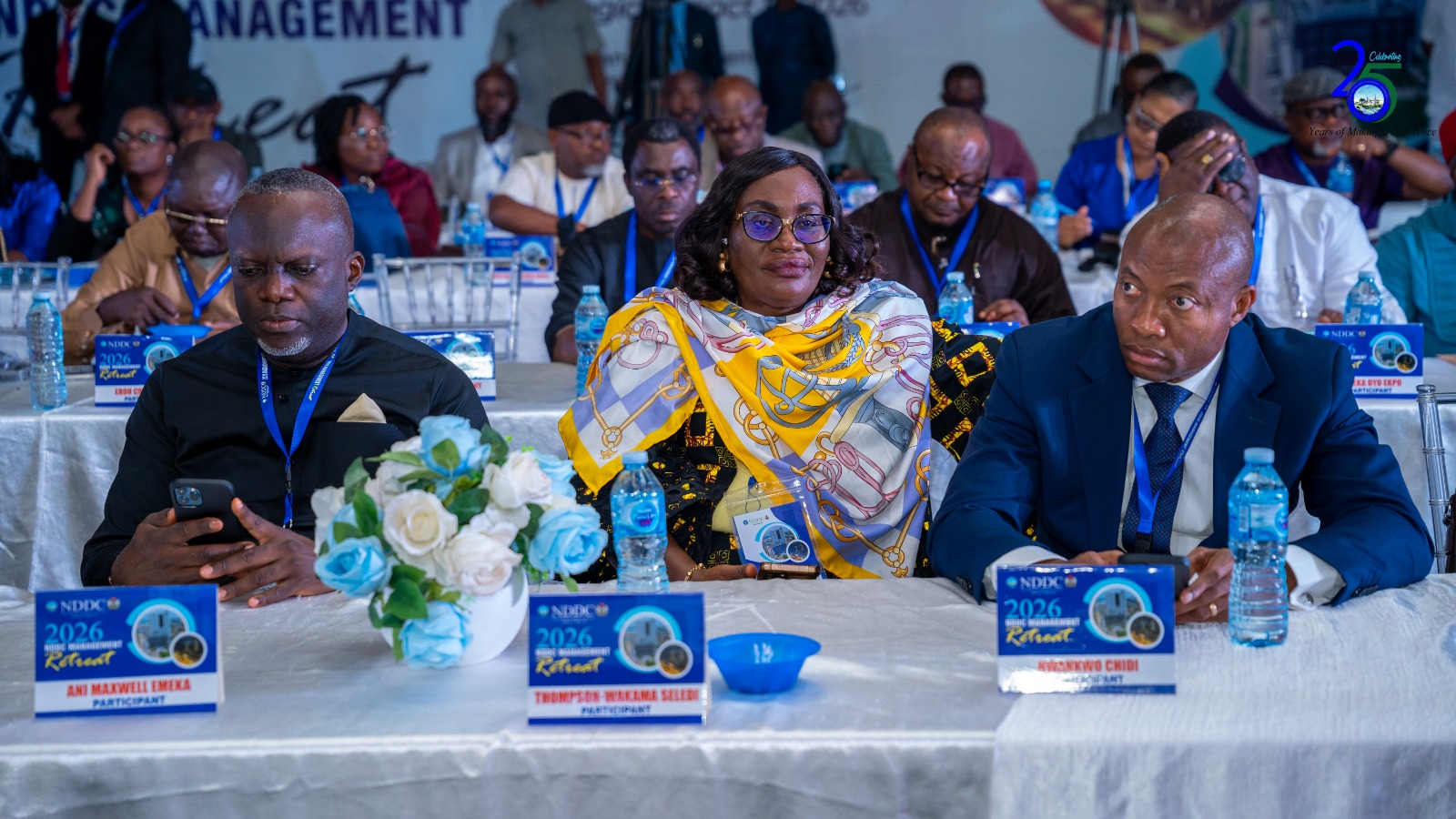
Those were the words of the Managing Director of the Niger Delta Development Commission, NDDC, Dr Samuel Ogbuku, as he espoused the Commission’s approach to laying the building blocks of development. Ogbuku explains that the new strategy is anchored on transparency and accountability. He re-echoed this view on February 12, 2026, during a two-day NDDC Management Retreat at the Landmark Events Centre, Owerri, Imo State.
According to the Managing Director, the Commission’s 2026 Management Retreat, with the theme: “Consolidating Performance and Repositioning the Commission for Strategic Impact in 2026,” is a deliberate, strategic step toward institutional self-examination and a renewed focus. The retreat focused on strengthening governance and improving project and service delivery. Giving further insights, Ogbuku said: “It provides us with the opportunity to reflect on our shared commitment to strengthening performance, aligning our priorities with measurable outcomes, and advancing a results-driven agenda that delivers sustainable impact for the people of the Niger Delta.
“As we transition into a new operational year, it is both timely and necessary to pause, reassess, and realign. The retreat also offers a strategic platform to deepen our collective understanding of the Commission’s standards of operation and code of conduct, which remain the bedrock of our service delivery. It will enable us to reflect on our institutional values, reassess our processes, and ensure that our actions remain fully aligned with our mandate and the expectations of the public we serve.
“Beyond policy engagements, the retreat underscores the need for renewed internal cohesion, stronger collaboration, and mutual accountability across all levels of the Commission. By fostering unity of purpose, enhancing communication, and reinforcing ethical standards, we are better positioned to improve efficiency, promote transparency, and deliver greater developmental impact across the Niger Delta region.
“This retreat is not merely a moment of reflection; it serves as a catalyst for innovation, teamwork, and sustained institutional excellence. It provides a structured platform to review our performance, consolidate our gains, address emerging challenges, and agree on a clear and strategic direction for 2026.
Guided by core objectives, including performance review and stocktaking, strategic agenda setting, strengthening leadership relationships, driving action-oriented outcomes, and reinforcing a culture of accountability, the 2026 Management Retreat will position the Commission for a more focused, disciplined, and impactful year ahead.”
The NDDC boss affirmed that the Commission has started implementing a new Governance Advisory Report as part of its strategy to consolidate its performance and reposition itself for greater impact in the year ahead. Ogbuku stated that the Commission was already implementing the Governance Advisory Report prepared by the multinational business management consultancy firm KPMG to facilitate its transition from transactional to transformational mode.
According to him, the KPMG report provides the tool for a new institutional culture, anchored in sound ethics and good corporate governance, to improve NDDC’s internal processes and protocols.
He urged members of the NDDC Governing Board and Management Committee to be deliberate in avoiding the mistakes of the past, even as the experiences have shaped the Commission’s present reality.
Ogbuku declared: “The 2026 NDDC Management Retreat offers a strategic platform for us to deepen our collective understanding of the Commission’s Standard Operating Procedures, SOP, and code of conduct, which remain the foundation of our service delivery. It is an opportunity to reflect on our institutional values, reassess our operational processes, and ensure that our actions consistently align with the Commission’s mandate and public expectations.
“Beyond policy discussions, this gathering calls for a renewed commitment to strengthening internal cohesion, collaboration, and mutual accountability across all levels of the organisation. By fostering unity of purpose, improving communication, and reinforcing ethical standards, we can enhance efficiency, promote transparency, and position the Commission to deliver greater impact in the Niger Delta region.
“Let us therefore use this retreat not only as an opportunity for reflection, but as a catalyst for innovation, teamwork, and sustained institutional excellence.”
Ogbuku called on the Directors to practice good governance by implementing the basic rules, practices, and processes of corporate governance and adopting a set of relationships among the organisation’s board, management, and key stakeholders.
Speaking earlier, the NDDC Director, Planning, Research and Statistics, Dr Patterson Ogon, affirmed that the Commission remained committed to facilitating sustainable development across the Niger Delta. “Achieving this mandate, however, requires deliberate planning, strong coordination, and a shared sense of purpose,” he said.
He stated further: “This retreat provides a structured platform to set a clear direction for 2026. It offers an opportunity for performance review and stocktaking, particularly regarding project delivery and the Commission’s strategic agenda. It also enables Management to clearly define roles and responsibilities, align priorities, and establish action-oriented outcomes.
“Above all, the retreat reinforces our accountability framework and strengthens our performance architecture, ensuring that our collective efforts translate into measurable impact for the people of the Niger Delta.” Ogon, noted that the retreat aimed to evaluate past performance and set a transformative agenda for the region’s development in the coming year.
Speaking on the topic, “Consolidating Organisational Performance Through Human Capital, Change, and Team Alignment,” the Lead Presenter and Director of Studies at the Administrative Staff College of Nigeria (ASCON), Dr Dada, Joseph Olugbenga, urged the NDDC to emphasise teamwork and strive for robust engagement on key issues affecting the Niger Delta region.
He advised the NDDC to focus on consolidating performance, strengthening governance, and repositioning the Commission for greater strategic impact.
He stated: “In order to effectively align the existing human capital of the Commission to NDDC 2026 performance priorities, the following becomes paramount:
Understand that strategic alignment is a strategic approach that should treat employees not as costs but as valuable, intangible assets capable of driving competitive advantage, innovation, and sustainable growth.
“There is a need for a continuous appraisal of the HR to know if it is fit-for-purpose through skills gap analysis. That is, identify the existence, if any, of any difference between existing skills (ES) and required skills (RS), which can be addressed through training and non-training interventions.
In his paper, entitled “From Strategy to Impact: Practical Repositioning of NDDC in 2026, One of the retreat facilitators, Dr Collins Edebiri, observed that “Effective staff treatment in the public service directly impacts performance and results.
He added: “Reforms may involve planned or unplanned changes, implemented either gradually or incrementally. Ensuring role clarity requires clear job descriptions, communicated expectations, regular feedback, and consistent check-ins.
“At the operational level, building a strong performance culture requires clear targets, measurable performance indicators, and regular check-ins. Success at departmental and unit levels should reflect alignment of people with priorities, faster execution, and improved outcomes.
“Overall, the accountability framework is vital at this time to drive alignment, strengthen leadership effectiveness, close performance gaps, and ensure sustainable impact across the Commission.”
The NDDC Director of Corporate Governance and Due Process, Mr Stephen Nzelaw, spoke on Strengthening Governance and Performance Discipline Through Standard Operating Procedure (Sop).
He highlighted the major ingredients necessary to boost governance and performance in any organisation. He stated: “While strong leadership is good, a strong institution is better as it ensures, that progress does not end with leadership and also guarantees a situation where organisations create and enforce objective rules, checks and balances that reduce reliance on a single leader’s whims and tribal knowledge, provides efficiency by institutionalised processes that reduce waste, corruption and external interference which distort public policy and twist the arms of Management.
“However, the choice is not between strong leadership and strong institutions. Strong leadership is necessary to build a strong institution for sustainable development.”
Speaking on Sop and Performance Discipline, Nzelaw explained: “SOP sets performance standards through Key Performance Indicators (KPIs) and serves as the basis for performance appraisals and evaluations.
“This guides employees in knowing whether they are meeting performance expectations, provides an opportunity for performance improvement, and serves as an objective criterion for rewards and punishments. The HR SOP provides the protocols for operationalising the Employee Performance Management framework, as mandated by the Federal Government in the PSR. Adherence to the SOP is linked to employee performance management metrics. There is reward and discipline for compliance.
He noted that using SOP minimises unpredictable outcomes and ensures high quality, consistency, and reliability. It also eliminates trial-and-error, saving time and resources.