


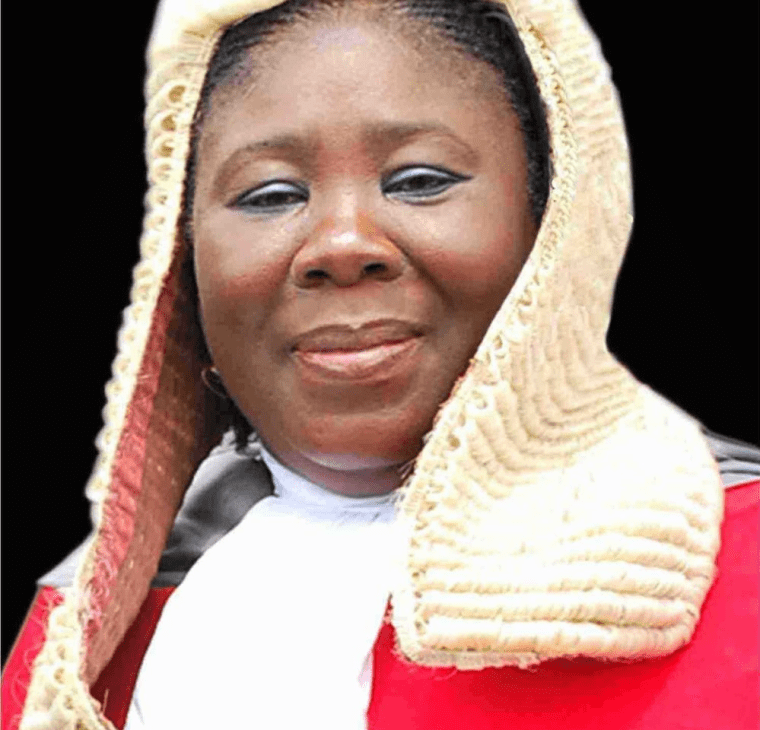
Nigeria’s judicial watchdog, the National Judicial Council (NJC), has cleared the Chief Judge of Osun State, Justice Oyebola Ojo, of all allegations of financial impropriety and judicial misconduct, delivering a decisive rebuke to claims that had fuelled a prolonged crisis within the state’s judiciary.
The decision was reached at the Council’s 110th meeting, held on Wednesday under the chairmanship of the Chief Justice of Nigeria (CJN), Justice Kudirat Kekere-Ekun.

In a statement issued after the meeting, the NJC’s Deputy Director of Information, Kemi Babalola-Ogedengbe, said the Council unanimously adopted the findings of a three-member investigation committee set up to examine multiple petitions against Justice Ojo.
*Petitions dismissed after probe
The petitions were filed by Eludire Kunle, a staff member of the Osun State Customary Court of Appeal and chairman of the Judiciary Staff Union of Nigeria (JUSUN) in the state, alongside three others. Additional complaints were submitted by the Speaker of the Osun State House of Assembly, Adewale Egbediran; Temitope Fasina; and a joint petition by the Osun State Attorney-General, Oluwole Bada, with four purported members of the State Judicial Service Commission.
Justice Ojo was accused of unilaterally suspending judiciary staff, engaging in selective promotions, halting training programmes, disobeying court orders, and misappropriating public funds. Specific allegations included the diversion of ₦7.4 million earmarked for judges’ and magistrates’ retreats, ₦5 million in robe allowances, and proceeds from e-affidavit services.
After reviewing documentary and oral evidence, the investigation committee found no proof of wrongdoing. It concluded that the suspension of judiciary staff followed due process and was based on recommendations from the appropriate disciplinary committee. The panel further affirmed that staff training and promotions fell within the statutory powers of the State Judicial Service Commission.
Crucially, the committee found no evidence that Justice Ojo misappropriated robe allowances, retreat funds, or e-affidavit revenues, nor that she personally benefited from any financial transactions.
On the basis of these findings, the committee recommended the outright dismissal of all petitions—a recommendation the NJC fully upheld.
*A judiciary in turmoil
The NJC’s decision comes against the backdrop of a judiciary in Osun State that has been largely paralysed for over a year due to strike actions by JUSUN, driven by unresolved grievances and deep institutional rifts.
The crisis was further compounded by political intervention. In November 2023, Governor Ademola Adeleke suspended Justice Ojo as Chief Judge following allegations of misconduct, abuse of office and corruption raised by the Osun State House of Assembly. He subsequently named Justice David Afolabi of the High Court as Acting Chief Judge.
That move, however, triggered widespread backlash. Justice Afolabi declined the appointment, citing the governor’s failure to involve the NJC, as required by the Nigerian Constitution and established judicial precedents. He formally communicated his rejection to the Council.
At the time, the NJC—then chaired by former CJN Olukayode Ariwoola—directed the state government to maintain the status quo, stressing that only the Council had the constitutional authority to discipline judicial officers and recommend sanctions to a governor.
The Nigerian Bar Association (NBA) also condemned Justice Ojo’s suspension, describing it as unlawful, a violation of the separation of powers, and a disregard for subsisting court orders.
*Other NJC decisions
Beyond the Osun case, the NJC also dismissed a petition against Justice Gentu Timi of the Delta State High Court after the complainant withdrew the case following the resolution of a chieftaincy dispute.
In a significant reversal, the Council set aside the one-year suspension without pay earlier imposed on Justice Jane Inyang of the Court of Appeal, Uyo Division.
Justice Inyang had been sanctioned over alleged improper ex parte orders granted while she served at the Federal High Court.
The NJC ruled that the petition was filed outside the statutory six-month window and related to a matter already under appeal.
Overall, the Council reviewed 39 petitions through its Preliminary Complaints Assessment Committees, dismissing 26 as lacking merit, recommending seven for further investigation, and issuing cautions to two judicial officers over procedural lapses, including delayed judgments and inappropriate language.
Reiterating its reform stance, the NJC warned judges against the indiscriminate grant of ex parte orders and urged Heads of Court to exercise restraint when assigning complex cases to newly appointed judges.