

Ondo town is more than a dot on the map of Nigeria; it is a living sanctuary of history, culture, and spirit. It is the ancestral seat of the Osemawe, the custodian of tradition and the spiritual compass of his people. Within this town of deep roots and enduring values lives Adewole Ebenezer Adebayo—quietly, purposefully—whenever he is home in the country and away from his Abuja residence.
His presence in Ondo is not announced by sirens or spectacle, but by an almost meditative simplicity that mirrors the soul of the land itself.

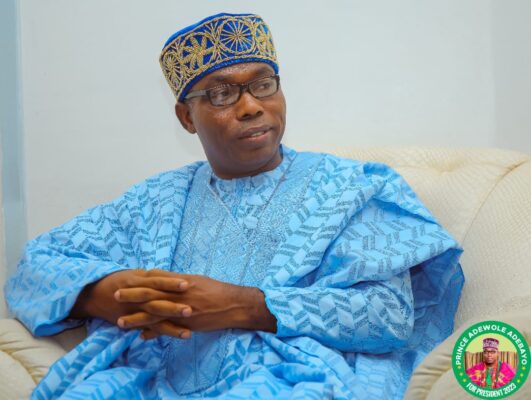
Adebayo is of royal blood, born into a lineage that carries the weight and dignity of the Osemawe throne. He is a man with the pedigree, the preparation, and the poise to one day ascend that ancient seat. Yet even now, he serves as an unofficial envoy of the Osemawe Kingdom—an ambassador whose reach extends across borders, continents, and conversations, carrying the spirit of Ondo into the wider world.
What is most striking about him, however, is how unassuming he is.
You could walk past him on the street and never turn your head twice. He looks like the neighbour next door—no aura of entitlement, no performance of wealth or influence. There is nothing flamboyant about him, nothing designed to impress at first glance. And yet, beneath that modest exterior lies a depth that only reveals itself with time.
What Adebayo does not display in material excess, he more than compensates for in intellect and enterprise. Trained as a lawyer, his professional life refuses to be confined to a single discipline. Like an octopus, his reach extends into multiple sectors: agriculture and mechanised farming, legal practice, mining, ranching, media, real estate, and marketing.
In every space he occupies, he brings clarity of thought and firmness of execution. He is gifted with words that persuade and ideas that endure. Young, brilliant, blunt, and deeply practical, he is a man who speaks plainly and acts decisively.
It is only when one steps into his expansive, gated compound that the fuller picture begins to emerge. There, five imposing storey buildings rise, all in white colour, each crowned with a rooftop that seems designed not merely for elevation, but for communion—spaces where people gather, converse, and celebrate life. These buildings are alive with movement, housing family members, friends, and a steady stream of visitors.
Behind them stands yet another testament to vision in motion: a glass edifice, also three storeys high, still under construction, quietly declaring that growth is a continuous journey, never a destination.
Yet, architecture is not the true marvel of this place. Humanity is.
Within Adebayo’s home, food has no gatekeeper. Hunger is not interrogated; it is simply answered. Visitor or stranger, acquaintance or passerby—once you find yourself within the compound, you are fed.
The kitchen operates like a living organism, awake from morning till night. Caterers work relentlessly, preparing meals every single day, not as an act of charity alone, but as a philosophy: that sustenance is a shared human right.
Across more than ten hectares of land, people from all walks of life live, move, and grow. Some are known to Adebayo; many are not. Names are not a prerequisite for care. They are housed, they are fed, and their children are educated. School fees are paid.
School buses—provided by him—move through the environs daily, ferrying students to and from their classrooms with quiet efficiency. Without fanfare or publicity, Adebayo practices philanthropy on a scale that defies assumption. His scholarship scheme, running into hundreds of millions, is guided by just two criteria—be indigent and be brilliant. Nothing more. Nothing less.
And then, there is the rhythm that has recently captured his heart: the marathon.
To Adebayo, marathon running is not merely a sport; it is a language. It is a philosophy of life, a social adhesive, a powerful tool for uniting people—especially the youth—around the timeless value of endurance.
In a world increasingly obsessed with shortcuts and instant gratification, the marathon stands as a quiet rebellion. It teaches patience. It rewards preparation. It honours discipline.
Marathon, he believes, gives people purpose. It invites them to test their strength and stamina, not against one another alone, but against their own limits. It places individuals side by side on the same road—this is me, this is you—each running at their own pace, yet moving in the same direction.
For Adebayo, success is simply endurance made visible. To succeed, you must plan. You must focus. You must work hard. You must project beyond the present moment. You must prepare for what lies ahead, compete with integrity, and endure with grace.
This is true for individuals, and it is equally true for nations. Just as people run their personal races, companies run theirs, communities run theirs, and countries do the same. Development, in its truest form, is not a sprint. It is a marathon.
Though he is deeply involved in numerous sports—judo, basketball, boxing, wrestling, swimming—today, the marathon carries the message. Tomorrow, another discipline may take the stage. What remains constant is the spirit: sportsmanship, discipline, unity, and collective purpose.
A nation of sportspeople, Adebayo insists, is an active nation. Sport is the gateway to good health, to strong moral fibre, and even to national strength and security.
Begin with the young, and you shape the future. To wake up every morning and train for a marathon scheduled a year away is to learn commitment, patience, and self-belief.
It is to understand delayed gratification and to become part of a global community bound by effort, respect, and resilience.
Even the land itself seems to conspire with this vision. Ondo City, with its notable elevation, echoes the highlands that have produced some of the world’s greatest long-distance runners. Just a few kilometres from surrounding ranges, the terrain naturally invites endurance and rewards discipline.
The soil, the air, the incline—all seem to whisper the same message: keep going.
In Ondo, through the vision of one man, the marathon has become more than a race. It has become a bridge—between people and purpose, privilege and service, strength and compassion.
It is a bridge between today’s disciplined effort and tomorrow’s united nation, steadily running toward a future shaped not by haste, but by endurance.